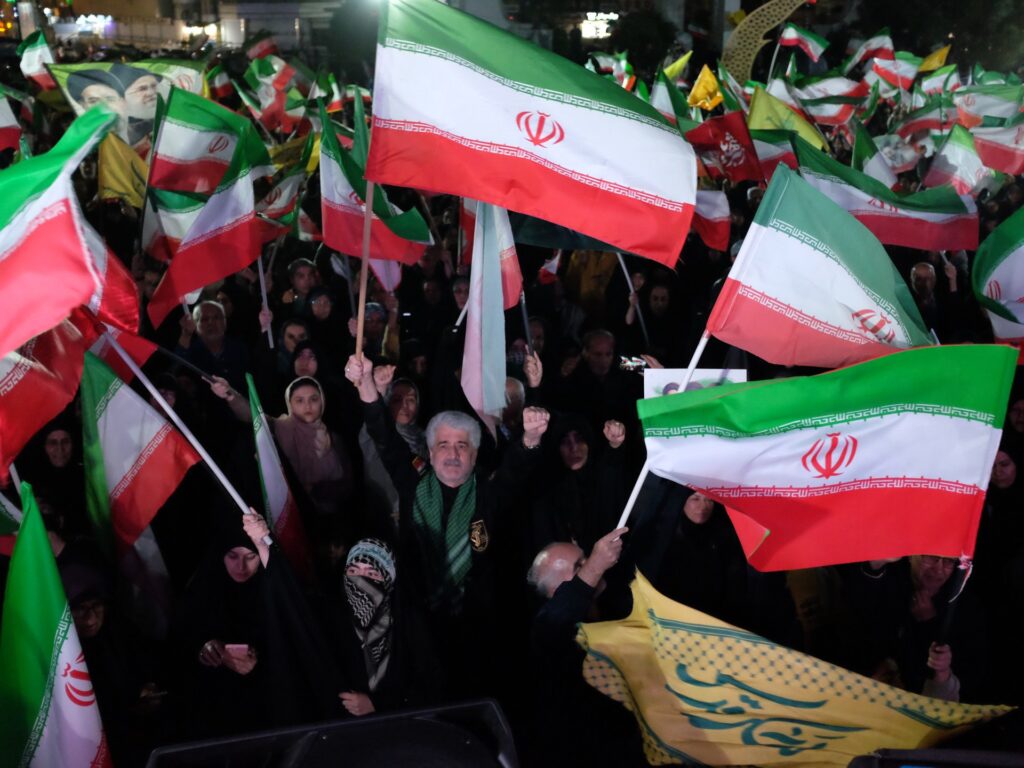
Former U.S. President Donald Trump recently described Iran’s leadership as “fractured,” casting doubt on the cohesion and stability of the country’s ruling elite. This claim comes more than 50 days into a significant conflict involving Iran, raising questions about the internal dynamics of one of the Middle East’s most pivotal governments.
Iran, governed by a complex system that intertwines religious authority and political power, is often perceived as monolithic by external observers. However, the internal mechanisms of power are layered, with multiple institutions and figures exerting varying degrees of influence.
Central to Iran’s governance is the Supreme Leader, a position held currently by Ayatollah Ali Khamenei, who wields immense control over the military, judiciary, and state media. The Supreme Leader is supported by the Guardian Council and the Expediency Discernment Council, bodies that regulate legislation and political disputes.
Despite Trump’s assertions, analysts and experts monitoring the situation report little evidence of genuine fragmentation or instability within the Iranian ruling apparatus. The Revolutionary Guard Corps (IRGC) and the regular military forces continue to operate under unified command, emphasizing regime stability rather than division.
Political factions within Iran do exist, ranging from hardliners to moderates, each pushing different agendas. Still, these factions generally coalesce around the survival and continuity of the Islamic Republic, particularly when faced with external threats.
Recent events in the ongoing war have tested Iran’s leadership, but so far, the government has displayed remarkable resilience and cohesion. Decision-making processes seem coordinated, with no public or known significant schisms that could suggest a fractured leadership.
Trump’s characterization might stem from a broader U.S. narrative aiming to portray Iran as unstable and vulnerable, thereby justifying strategic policies such as sanctions or military posturing. However, on closer examination, Iran’s leadership structure remains intact and operational.
Who, then, really is in charge? Undoubtedly, Ayatollah Khamenei sits at the apex of Iran’s power pyramid, supported by loyal factions within the IRGC and political elites. Presidents and parliament members, while influential, often act within frameworks defined by the Supreme Leader and his close circle.
The lack of visible fractures does not negate the presence of underlying tensions or competing interests within Iran’s political landscape. Still, these internal dynamics appear well-managed and controlled, largely shielded from open conflict or destabilization.
For policymakers, analysts, and observers, understanding the nuances of Iran’s leadership is crucial. Simplistic portrayals of fragmentation may mislead international strategies and underestimate Iran’s capacity for unified action.
As the conflict continues, the resilience of the Iranian government will be a key aspect to monitor. Debates about fragmentation should be informed by rigorous analysis rather than rhetoric, considering both public statements and the realities of power within Tehran.
In summary, despite Trump’s statement, the evidence suggests that Iran’s leadership remains cohesive and firmly in control. The Supreme Leader, backed by powerful institutions and loyal factions, continues to direct the country amidst ongoing war and external pressures. This unity underlines the importance of nuanced understanding of Iranian politics, far beyond headline claims.