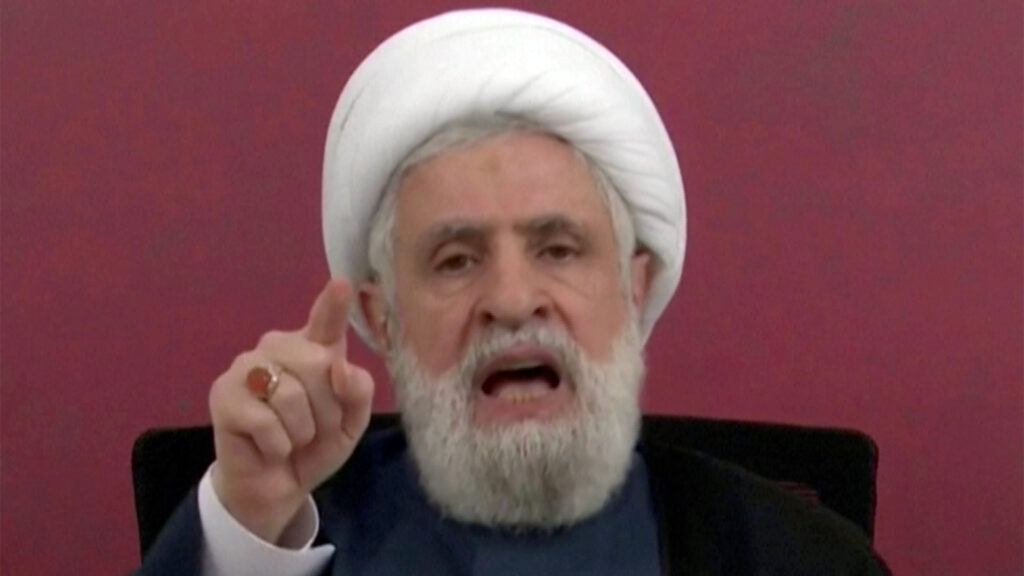
Hezbollah, the powerful Lebanese political and militant group, has emphatically rejected Lebanon’s decision to engage in direct negotiations with Israel. The party’s deputy leader, Naim Qassem, strongly urged the Lebanese government to cancel a planned meeting in Washington that would bring Lebanese and Israeli representatives face-to-face.
The context behind this meeting stems from longstanding tensions between Lebanon and Israel, particularly concerning disputed border areas and maritime resources. Lebanon’s government, under increasing pressure to resolve these conflicts peacefully, sought a direct dialogue facilitated by the United States in the hopes of reaching a mutually acceptable agreement.
However, Hezbollah, which wields significant influence over Lebanese politics and security, views any direct negotiations with Israel as unacceptable. Qassem argued that such talks undermine Lebanon’s stance and fail to account for Israel’s history of aggression and violations of Lebanese territory.
Hezbollah’s opposition is rooted in its broader resistance to Israel’s policies and military actions in the region. The group has traditionally championed armed resistance over diplomatic engagements, positioning itself as a defender of Lebanese sovereignty against Israeli incursions.
The planned Washington meeting was said to focus on resolving maritime border disputes in the Mediterranean Sea, where potential oil and gas reserves have escalated tensions. Lebanon claims certain maritime zones that Israel also asserts rights to, making the area a flashpoint for future conflicts.
In his statements, Naim Qassem highlighted that Hezbollah views these talks as illegitimate and warned that any agreements reached under such conditions would be rejected by key Lebanese factions and the population. He urged the government to reconsider its approach and seek alternative methods that do not involve direct interaction with Israel.
Lebanese officials, meanwhile, have expressed cautious optimism about the diplomatic initiative, emphasizing the need to safeguard Lebanon’s economic interests and national sovereignty. Negotiators hope that the U.S.-facilitated talks might prevent potentially costly confrontations that could destabilize the already fragile region.
This divergence between Hezbollah and the Lebanese government underscores the complex political dynamics within Lebanon. The country is balancing pressures from international stakeholders, internal political factions, and security concerns related to the ongoing Israeli-Lebanese conflict.
Analysts suggest that Hezbollah’s rejection is likely to complicate the negotiation process and could trigger renewed tensions both politically and militarily. The group’s stance signals to Israel and the international community that any resolution of disputes needs broader consensus within Lebanon.
Moreover, Hezbollah’s position reinforces its role as a key player in Lebanon’s foreign policy and security decisions. The group’s military capabilities and popular support make it a formidable force that any Lebanese government must consider when formulating strategies regarding Israel.
The rejection also reflects the deep-seated animosity and mistrust between Hezbollah and Israel, which have fought several conflicts, most notably the 2006 Lebanon War. As a result, Hezbollah’s rejection of direct talks is likely to resonate beyond Lebanon, influencing broader Middle East geopolitics.
For now, the planned meeting in Washington remains uncertain as Lebanon weighs Hezbollah’s objections against its own diplomatic objectives. How Lebanon navigates this dilemma will have significant implications for regional stability and the future of Lebanese-Israeli relations.
In conclusion, Hezbollah’s explicit rejection of Lebanon’s direct negotiations with Israel portrays the enduring complexities of achieving peace in the region. The group’s call to cancel the Washington talks highlights ongoing divisions within Lebanon and the broader Middle East conflict landscape, underscoring the challenges facing diplomacy in resolving deep-rooted disputes.