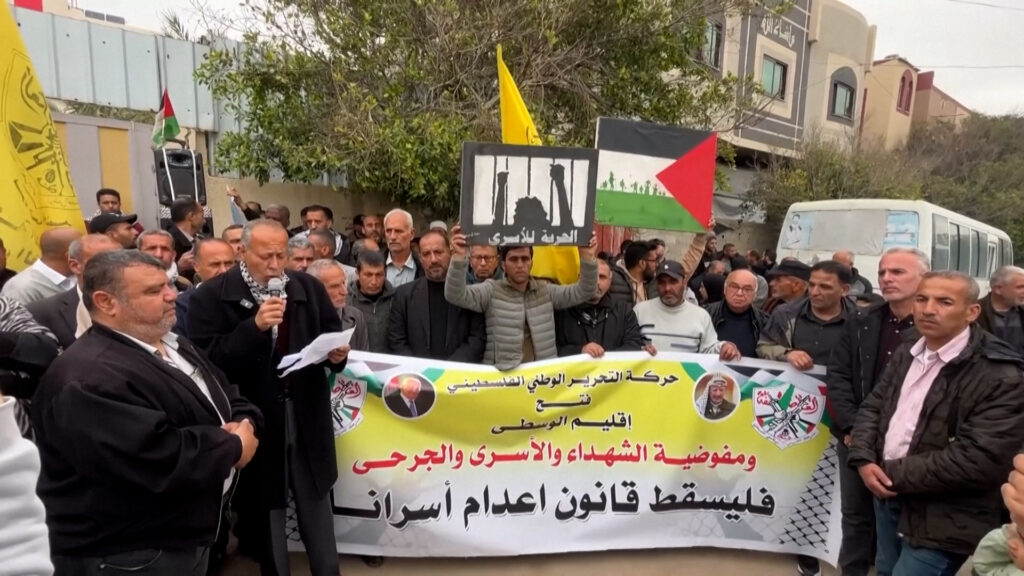
In recent days, Palestians in Gaza have taken to the streets in widespread protests condemning the Israeli government’s approval of a new death penalty law targeting Palestinian prisoners. The law, which authorizes capital punishment for alleged offenses committed by Palestinians, has sparked significant outrage among Palestinians and human rights advocates alike.
Protesters gathered across multiple locations in Gaza, carrying banners and chanting slogans denouncing what they describe as an unjust and brutal policy. Many fear the death penalty will lead to increased tensions and violations of international law, exacerbating the already volatile Israeli-Palestinian conflict.
The Israeli government approved this law as part of a broader toughening of policies against Palestinians accused of serious crimes, including terrorism-related charges. Officials supporting the law argue it is a necessary measure to deter acts of violence and protect Israeli citizens.
However, critics argue the death penalty is a disproportionate punishment that undermines prospects for peace and violates Palestinian prisoners’ human rights. Numerous Palestinian political factions and civil society groups have called for the law to be rescinded immediately.
The protests in Gaza reflect deep frustration within Palestinian society over ongoing restrictions, detentions, and the broader occupation. Demonstrators emphasize that justice should be pursued through fair trials that respect due process rather than through capital punishment.
International human rights organizations have also expressed alarm at the move, warning that the death penalty may lead to further escalation and suffering in the already tense region. They urge all parties to prioritize dialogue and peaceful resolution of conflicts.
The controversy surrounding the death penalty law highlights the deep divisions and continuing challenges in Israeli-Palestinian relations. While the Israeli government sees it as a security necessity, Palestinians view it as a severe violation of their rights and dignity.
As protests continue in Gaza and possibly beyond, the international community watches closely, hoping for steps toward de-escalation and respect for human rights. The situation remains fluid, with both sides facing critical decisions about the future of justice and peace in the region.
This development adds to the complex and painful history of conflict between Israel and Palestine, underscoring the urgent need for renewed efforts to address the root causes of violence and build lasting peace.