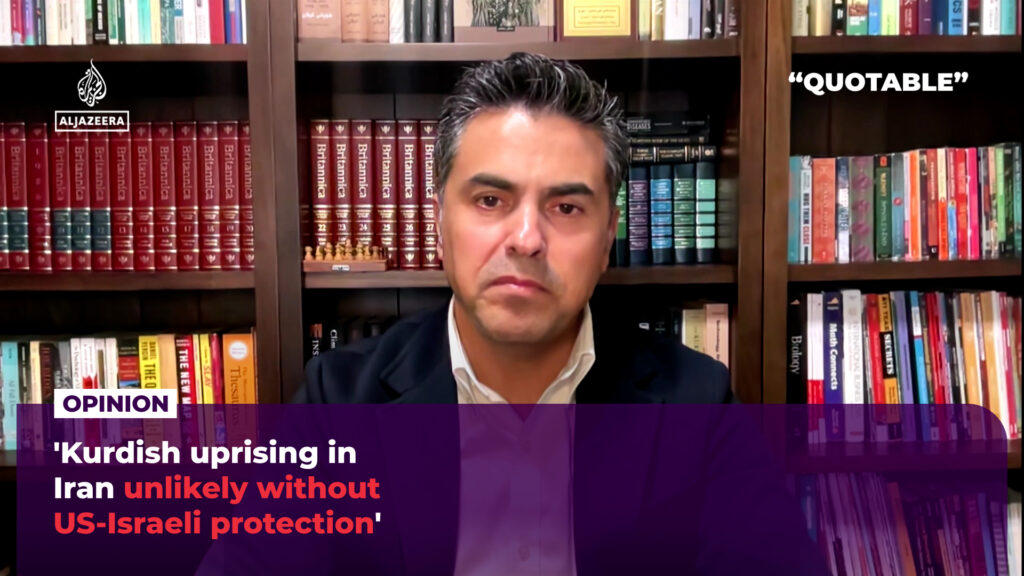
Yerevan Saeed, a prominent analyst specializing in Middle Eastern affairs, has made a significant observation regarding the potential for a Kurdish uprising within Iran. Saeed contends that without external support, particularly from influential international actors like the United States and Israel, Kurdish forces inside Iran would find it extraordinarily difficult to mount and sustain an effective rebellion.
The Kurdish population in Iran, which comprises a substantial minority group predominantly residing in the northwestern provinces, has a long history of seeking greater autonomy and rights under Iranian governance. Despite periodic unrest and demands for political reforms, the prospect of a full-scale uprising has remained challenging due to the Iranian government’s strong security apparatus.
Saeed’s analysis points to the critical role of geopolitical backing in such conflicts. He suggests that Kurdish fighters would struggle to organize logistics, secure weapons, and maintain communication channels without the protection and resources that could be provided by external powers. The US and Israel, historically supportive of Kurdish groups in various parts of the Middle East, hold capabilities that could tip the balance of power.
This insight arrives at a time when regional tensions remain high. The Kurdish issue is a sensitive topic in Iran, a country fraught with complex ethnic dynamics and external pressures. While Iranian Kurdish groups have expressed dissatisfaction with the central authority, repeated crackdowns and lack of substantial international support have so far prevented a widespread insurgency.
Analysts highlight that any potential Kurdish uprising in Iran would not only be a matter of internal policy but also a factor in international relations, especially involving the US and Israel, who have their strategic interests in the region. Saeed’s comments underline the interconnectedness of domestic ethnic issues and global diplomatic strategies.
Iran’s government continues to assert its sovereignty and rejects foreign interference, viewing external support for Kurdish groups as a threat to its national security. Tehran has consistently accused foreign governments of fomenting unrest to destabilize the country. This narrative complicates the Kurdish groups’ position, as seeking international assistance may provoke harsher repression.
Moreover, in the broader context, Kurdish populations in neighboring countries such as Iraq, Syria, and Turkey have also experienced varied degrees of autonomy and conflict, often influenced by international geopolitical interests. The Iranian Kurdish situation is a part of this larger regional mosaic.
Yerevan Saeed’s perspective sheds light on the strategic dependencies that shape insurgent movements and ethnic dynamics in Iran. Without the backing of powerful allies capable of offering protection and resources, the likelihood of a successful Kurdish uprising in Iran remains minimal. This reality underscores the delicate balance of internal dissent and external influence in a geopolitically volatile area.