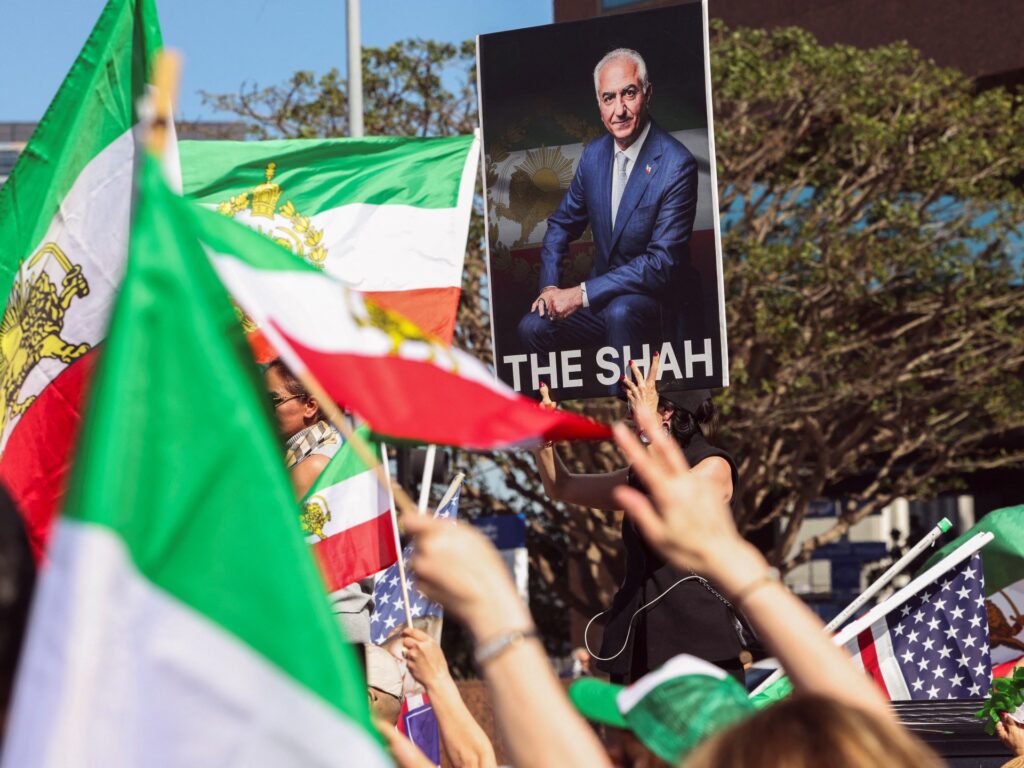
In recent developments on the geopolitical stage, U.S. President Donald Trump has publicly suggested that Reza Pahlavi, an exiled Iranian dissident and the son of the former Shah of Iran, could potentially assume leadership following the current Iranian Supreme Leader, Ayatollah Ali Khamenei. This announcement signals a significant moment in U.S. foreign policy rhetoric concerning Iran and its future governance.
Reza Pahlavi has long been a prominent figure opposing the Islamic Republic’s regime since its inception after the 1979 Iranian Revolution, which led to the establishment of the current theocratic state under Ayatollah Khomeini. Now, the mention of Pahlavi by President Trump elevates the exiled opposition leader’s profile on the international stage.
President Trump’s consideration of Pahlavi as a successor was communicated during an address on foreign policy, where he reflected on potential pathways for change within Iran. Trump described Pahlavi as a symbol of alternative governance, noting his advocacy for democratic principles, a secular government, and human rights in Iran.
Reza Pahlavi’s background includes decades of political activism from abroad, aiming to inspire and unite opposition groups within Iran and the global diaspora. He advocates for a peaceful transition to democracy, specifically calling for the end of clerical rule and for establishing freedoms that are currently suppressed under the Islamic Republic.
The context of Trump’s remarks ties into heightened tensions between the U.S. and Iran, particularly with continuous disputes over Iran’s nuclear ambitions, regional influence, and human rights record. By acknowledging a figure like Pahlavi, Trump’s administration signals an openness to supporting a post-Khamenei leadership that diverges from the current regime’s policies.
However, the suggestion has elicited mixed responses internationally. Some critics argue that elevating a member of the former royal family may not resonate with all segments of Iranian society, especially given the complex history surrounding the 1979 revolution when the Shah’s government was overthrown due to allegations of tyranny and authoritarianism.
Supporters of Pahlavi assert that his vision for Iran’s future represents a vital alternative to the entrenched clerical regime, emphasizing modernization, democracy, and global cooperation. They see this as an opportunity for Iran to transition towards a more open and connected society with the United States and other Western countries.
The Iranian government has yet to officially respond to President Trump’s comments regarding Pahlavi. Any move toward regime change remains speculative and fraught with geopolitical risks, considering Iran’s powerful Revolutionary Guard Corps and the complex web of regional alliances.
Political analysts suggest that Trump’s remarks could be aimed at encouraging internal dissent within Iran or signaling to allies that the U.S. is prepared to explore all options for challenging the current regime’s legitimacy.
Meanwhile, Reza Pahlavi himself has remained committed to non-violent advocacy and remains a vocal critic of the Islamic Republic’s policies. He has urged the international community to continue supporting the Iranian people’s aspirations for freedom and democracy.
This development marks a critical juncture in U.S.-Iran relations and the broader Middle Eastern geopolitical landscape. How the situation evolves remains to be seen, but President Trump’s public contemplation of Pahlavi as a future leader underscores ongoing tensions and the search for potential solutions to one of the world’s most enduring conflicts.