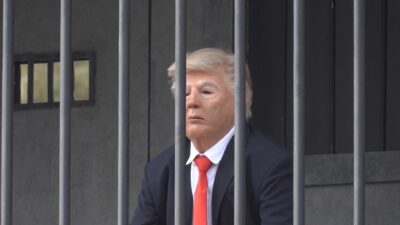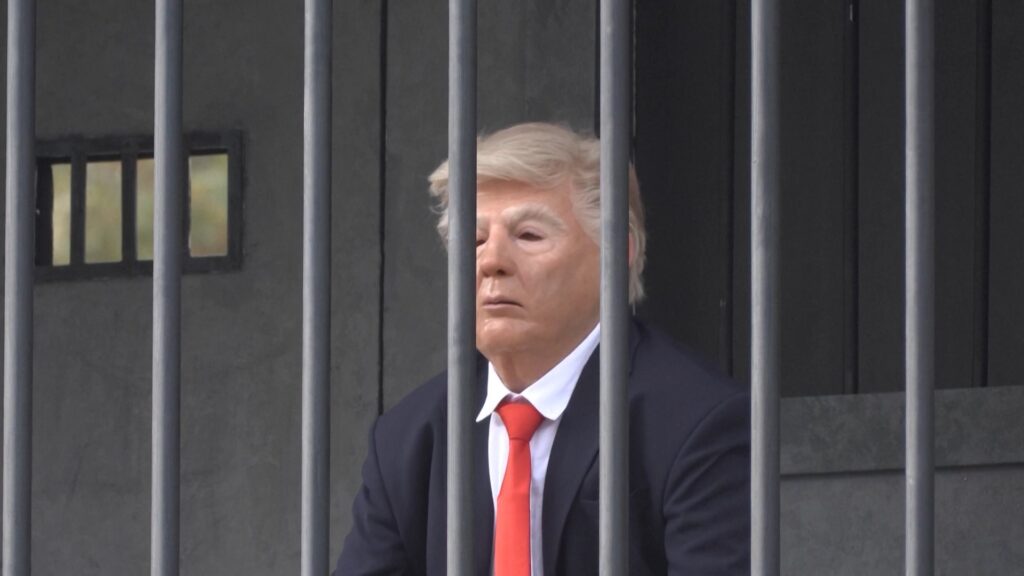
In a striking display of political satire, Tehran’s bustling Tajrish Square recently became the stage for a provocative mock installation featuring an impersonator depicting former US President Donald Trump behind bars. This installation reflects the heightened political tensions and anti-American sentiments that persist in certain segments of Iranian society.
The performer, who bears a striking resemblance to Donald Trump, was seen confined within a makeshift jail cell, drawing the attention of passersby in one of Tehran’s busiest public spaces. The scene was designed not only to entertain but also to send a strong political message regarding the contentious relationship between Iran and the United States.
This theatrical portrayal aligns with ongoing governmental narratives and public displays in Iran that critique US policies, particularly those implemented during and following Trump’s administration. Trump’s tenure was marked by aggressive economic sanctions and diplomatic standoffs with Iran, which significantly impacted the region’s geopolitical climate.
Observers note that such performances serve a dual purpose: they provide a means for political expression among citizens and reinforce the official stance adopted by Iranian authorities. The use of satire and public art installations as tools of political commentary and protest has been a feature in Iran’s cultural landscape for decades.
The installation has sparked a range of reactions within Tehran. While some onlookers found the scene amusing and supportive of Iran’s political messaging, others viewed it as a provocative act that could escalate already tense international relations.
Historically, Tehran has been a center for intricate political statements made through art and public performances. This mock scene follows a series of similar demonstrations that have targeted Western leaders and policies perceived to undermine Iranian sovereignty.
The choice of Tajrish Square, a hub known for its vibrant street life and accessibility, was likely strategic in maximizing visibility and impact. The installation was accompanied by placards and media coverage that highlighted grievances regarding US foreign policy and the personal conduct of Trump during his presidency.
Such public displays are part of a broader pattern of cultural resistance and political theater in Iran. By placing Trump behind bars, the installation symbolically reverses the narrative, portraying the former leader as a figure of accountability and justice as perceived by those who oppose his policies.
In conclusion, the mock installation of Donald Trump behind bars in Tehran’s Tajrish Square is not just an artful act of impersonation but a potent political statement. It illustrates the continuing complexities and confrontations in US-Iran relations, underscoring how deeply politics permeates public life and expression in contemporary Iran.