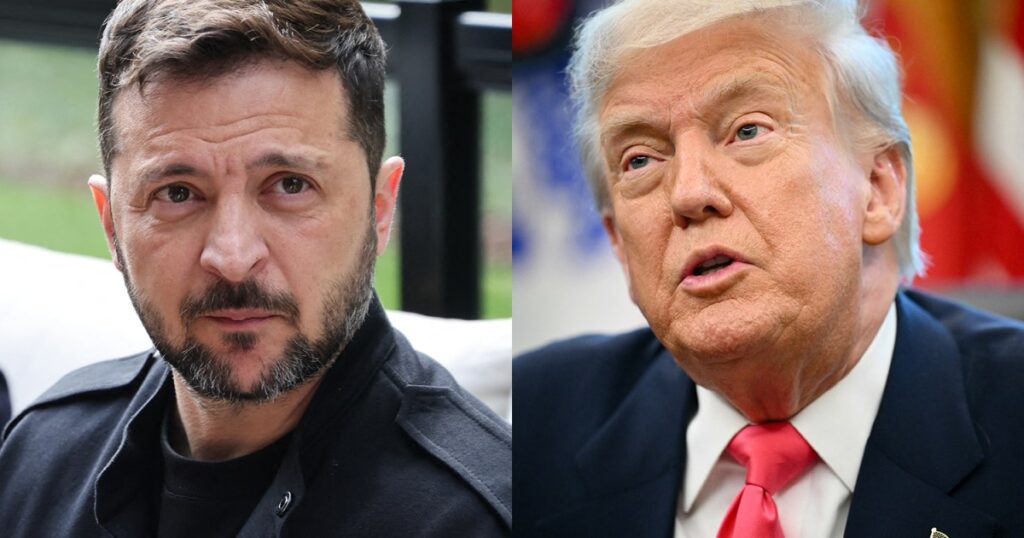
The relationship between former U.S. President Donald Trump and Ukrainian President Volodymyr Zelenskyy has been marked by a series of public and political tensions that have drawn international attention over the years.
The initial stages of their interaction began early in Zelenskyy’s first term, when Trump openly criticized U.S. military support to Ukraine. This policy stance reflected Trump’s broader skepticism toward foreign military engagements and aid, which he often framed within his ‘America First’ agenda.
From the outset, Trump’s remarks about Zelenskyy were notably critical, diverging from the traditionally cordial tone maintained by U.S. presidents with Ukraine’s leadership. This set a tone of discord that would later escalate.
A significant moment in the timeline was their meeting in the Oval Office, which unfortunately became the setting for a notable spat. Details of the exchange revealed disagreements not only on policy but also on the nature of U.S.-Ukraine relations and expectations for Ukraine’s role in regional security.
Following the Oval Office incident, the tension spilled into the public domain, with Trump delivering rebukes that questioned Zelenskyy’s actions and integrity. These public criticisms were unusual given the diplomatic norms usually observed between allies.
This strained relationship was further complicated by the broader geopolitical context, including Russia’s aggression in Eastern Ukraine and Crimea. Trump’s position towards Russia also influenced perceptions of his stance on Ukraine, as critics argued that his approach emboldened Russian actions.
Throughout this period, Ukraine’s reliance on U.S. military and economic support remained a critical issue. Trump’s criticism of this assistance raised concerns among U.S. allies and policymakers about the future of the U.S.-Ukraine partnership.
The timeline of Trump and Zelenskyy’s complex relationship underscores the challenges that arise when personal and political tensions intersect with international diplomacy. It highlights how the dynamics between leaders can influence broader geopolitical strategies and alliances.
Analysts suggest that the public nature of Trump’s critiques may have had implications not only for bilateral relations but also for the morale and strategic calculations within Ukraine itself.
As Ukraine continues to navigate its geopolitical challenges, the legacy of the Trump-Zelenskyy ties serves as a case study in the impact of leadership personalities on the conduct of international relations.
This timeline offers insight into how individual leadership styles and decisions can reverberate far beyond the confines of domestic politics, affecting international alliances and conflict resolution efforts on a global scale.