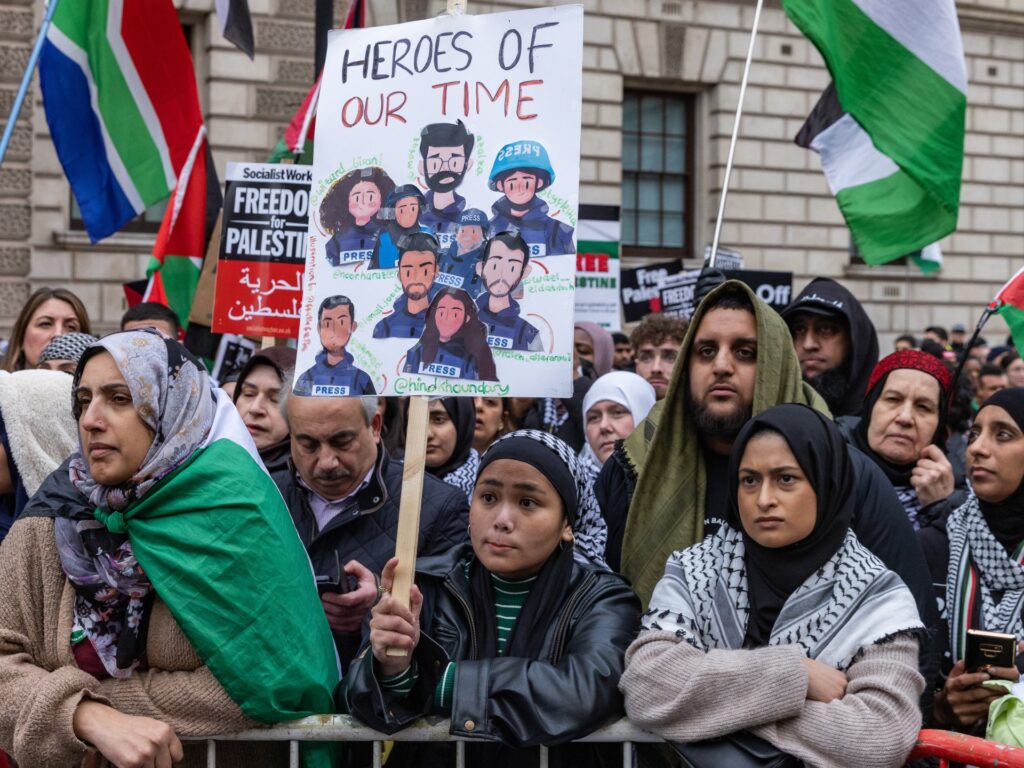
In the heart of one of the world’s most enduring and devastating conflicts, Palestinian reporters have emerged as beacons of resilience and courage. Challenging the harsh realities of Israel’s military actions, which many international observers and human rights organizations have labeled as acts constituting genocide, these journalists continue to report from the frontlines, bringing the unvarnished truth to the global stage.
Their work has not only provided a critical counter-narrative but also redefined the very essence of journalism under extreme conditions. Palestinian reporters operate under constant threat, facing the dual dangers of conflict violence and targeted suppression, yet they persist in their commitment to storytelling. This endurance amid adversity has spotlighted their pivotal role in conflict journalism, emphasizing witness testimony and a deep commitment to truth-telling.
Moreover, these journalists exemplify immense bravery and ethical responsibility as they report from a region where misinformation and propaganda often cloud the narrative. Their reports contribute essential, ground-level perspectives that challenge the dominant frames often perpetuated by mainstream Western media.
The scrutiny of Western media has intensified amid this backdrop. Many critics argue that Western outlets, instead of amplifying Palestinian voices and stories, have historically been complicit in promoting narratives that favor Israeli perspectives. This perceived bias has had profound implications, not only in shaping international public opinion but also in influencing policy debates and humanitarian responses.
Critics assert that by prioritizing Israeli security concerns and framing the conflict through this lens, Western media have marginalized the suffering of Palestinians and the perilous conditions faced by journalists reporting from Gaza. This has led to calls from global press freedom organizations and activists for a more balanced reportage that faithfully represents the complexity of the conflict and respects the dignity and safety of journalists.
The efforts of Palestinian reporters have thus sparked a wider dialogue about the responsibilities of the media during conflict. They challenge media consumers and outlets worldwide to reconsider whose stories are told and how narratives are constructed and disseminated.
Their defiance and dedication underscore a transformative moment in journalism, one that stresses the importance of truth, courage, and humanity. As they continue to document life under siege, Palestinian reporters reaffirm the power of journalism not only as a tool of information but also as an instrument of resistance and social change.
In this evolving media landscape, the call for Western media to review their journalistic practices gains urgency. There is a growing consensus that shedding any lingering bias and embracing a more inclusive, truthful, and nuanced approach could enhance public understanding and contribute to peace-building efforts.
Ultimately, the story of Palestinian reporters is not only about conflict coverage but also about the enduring spirit of journalism itself. Their courage sets a powerful example, reminding the world that truth has the power to challenge oppression and inspire change, even in the darkest of times.