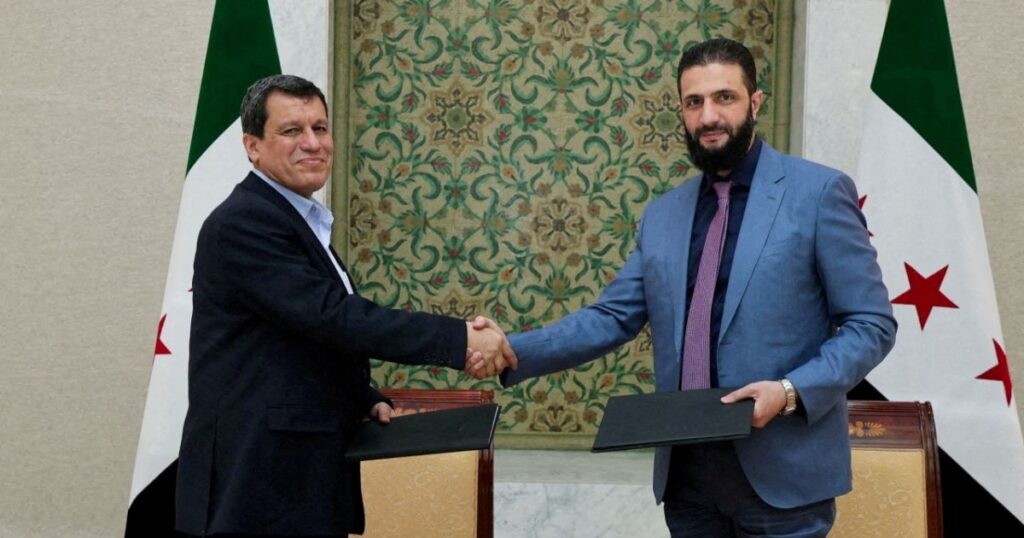
In a significant political move, Syrian President Ahmed al-Sharaa has appointed Mazloum Abdi, the former commander of the Kurdish-led Syrian Democratic Forces (SDF), as a presidential advisor. This appointment comes just three days after the official dissolution of the SDF, marking a notable development in Syria’s evolving political landscape.
Mazloum Abdi has been a prominent figure in the Syrian conflict, leading the Kurdish-led SDF, an alliance that played a crucial role in the fight against ISIS and maintaining security in northeastern Syria. His leadership was instrumental in both military operations and political negotiations involving Kurdish groups and the Syrian government.
The dissolution of the SDF, announced recently, signaled a shift in the dynamics of power and alliances within Syria. The SDF had been a critical force in the northern regions, often operating with considerable autonomy. By appointing Abdi as an advisor, President al-Sharaa is likely aiming to integrate former SDF leadership more closely into the central government’s framework.
This appointment is expected to have multiple implications. Politically, it may encourage greater Kurdish cooperation with Damascus, potentially easing tensions that have existed for years. Mazloum Abdi’s insider knowledge and influence could facilitate dialogue and contribute to more cohesive governance across Syria’s diverse ethnic groups.
Moreover, the move reflects an effort by the Syrian government to consolidate control and foster national unity after years of civil war and fragmentation. Incorporating a former SDF commander signals a willingness to reconcile and possibly address the Kurdish issue, which has been one of the most contentious and enduring conflicts within Syria.
Analysts suggest that Abdi’s new role could be a bridge for future political negotiations and a step toward stabilizing regions formerly under SDF control. It might also impact regional geopolitics, particularly in relation to Turkey and the United States, both of whom have vested interests in Kurdish affairs in Syria.
Historically, the Kurdish population in Syria has sought greater autonomy or federal arrangements, often clashing with the Damascus government. Mazloum Abdi’s transition from a military commander of an autonomous force to a presidential advisor may represent a strategic compromise benefiting both sides.
The appointment also raises questions about the future of the SDF fighters and the broader Kurdish political movement in Syria. As the SDF dissolves, many fighters could be integrated into national Syrian forces or demobilized, while political leaders like Abdi pursue influence through official governmental channels.
In conclusion, President Ahmed al-Sharaa’s move to appoint Mazloum Abdi as a presidential advisor marks a pivotal moment in Syria’s efforts to rebuild unity and stability. It underscores a willingness to engage with former opposition groups and highlights the complex process of reconciliation in a country still healing from years of conflict. Observers will be closely watching how this development unfolds and what it means for Syria’s future political order and security landscape.