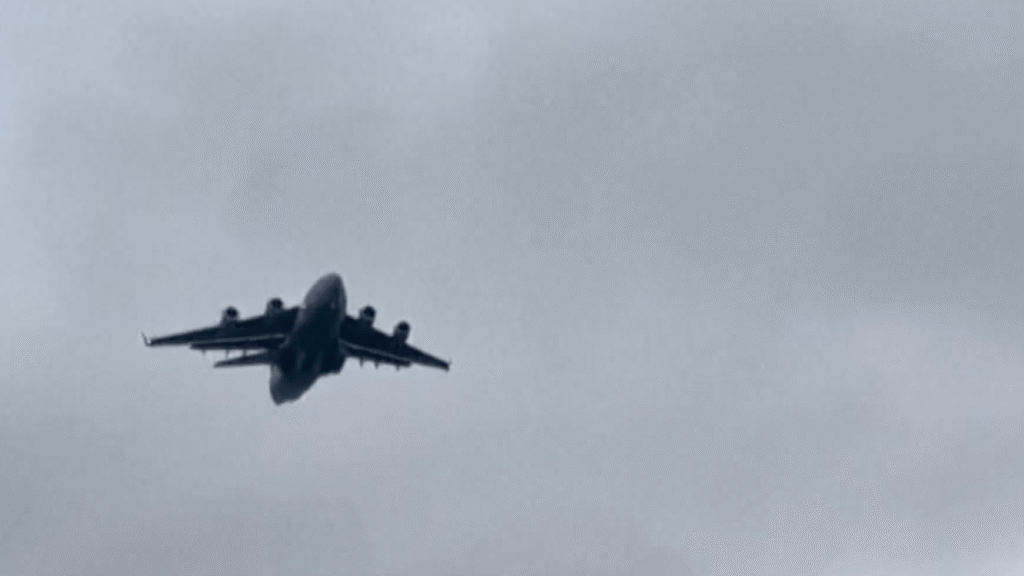
In an unusual and rare occurrence, a US military C-17 transport aircraft made a surprising landing at Moscow’s Vnukovo Airport. The aircraft arrived from Riga, Latvia, raising eyebrows given the sensitive nature of military flights and the geopolitical tensions often present in US-Russia relations.
The C-17 Globemaster III is a large military transport plane used primarily by the US Air Force for rapid strategic airlift of troops and cargo. Its landing at a major Moscow airport was not accompanied by an official explanation, which has led to much speculation among analysts and the public alike.
Typically, US military planes avoid Russian airspace and airports unless coordinated under specific agreements due to the often delicate diplomatic situations. This particular flight’s path from Riga, a NATO country and former Soviet state, to Moscow adds another layer of intrigue.
Officials from both countries have been tight-lipped. The US Department of Defense has neither confirmed nor denied the landing, while Russian authorities described the event as a “technical stop” without providing further information.
Experts suggest that such a technical stop could be for refueling or emergency reasons, or possibly to facilitate some form of diplomatic or logistical cooperation. This kind of cooperation, although rare, is not entirely unheard of between the two nations, which share responsibilities on various international issues.
The occurrence has triggered a wave of analysis concerning US-Russia military and diplomatic relations amid ongoing global tensions. The flight’s origin in Riga, a city hosting significant NATO operations, and its destination in Moscow, the Russian capital, raises questions about the purpose of the trip.
Some analysts posit that the landing could signal a backchannel communication or an upcoming diplomatic initiative meant to ease strained ties. Others view the event as a routine logistical maneuver misinterpreted by the public and media as something more significant.
The C-17’s rare landing in Moscow underscores the complexity of current international military logistics, where operational necessity can sometimes override political friction. It highlights how, even amidst tensions, certain pragmatic interactions still occur between opposing nations.
Observers continue to wait for official statements or further details that might clarify the circumstances surrounding the flight. Until then, the aircraft’s unexpected presence at Moscow’s Vnukovo continues to be a topic of keen interest and speculation worldwide.
This incident also prompts broader reflection on how military and diplomatic activities intersect and the opaque nature of such operations that often remain shielded from public scrutiny. It serves as a reminder that behind the scenes, various forms of cooperation or unexpected events may take place without immediate public awareness.
As global dynamics remain fluid, the transport plane’s landing stands as a symbol of the unpredictable nature of international relations and the occasionally unseen channels of communication that persist in times of tension.
In summary, the US military C-17’s landing in Moscow represents a rare and curious event that has captured attention and highlighted the nuanced and often complex connections between countries with a history of rivalry and competition.