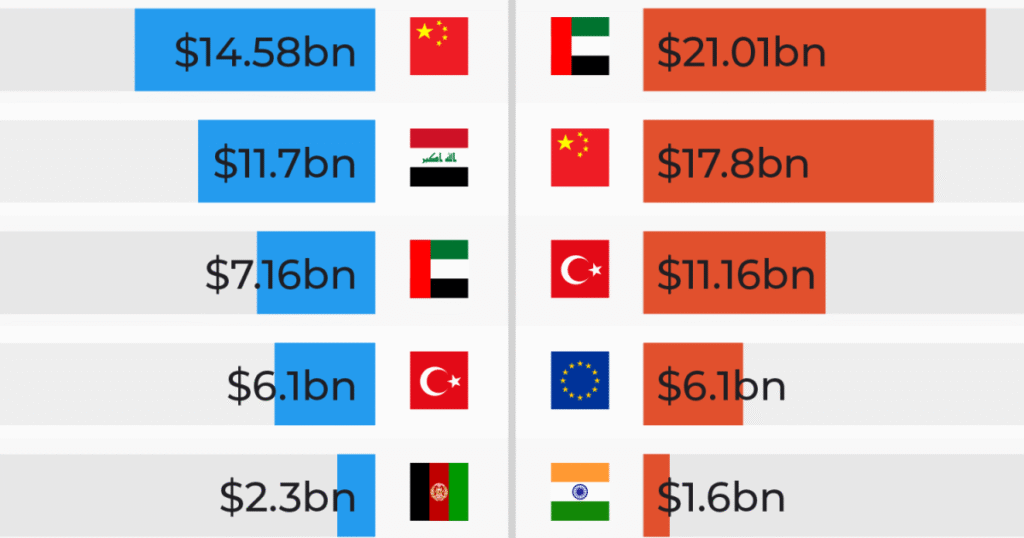
The United States aims to isolate Iran from the global economy as part of its ongoing efforts to curb Tehran’s influence and nuclear ambitions. Understanding Iran’s top trading partners is essential for identifying which countries the U.S. may focus on to successfully implement this isolation.
Iran’s economy, heavily reliant on oil exports, trades extensively with several countries across Asia, Europe, and the Middle East. Here are the key players in Iran’s international trade:
1. **China:** China’s position as Iran’s largest trading partner is pivotal. It imports significant volumes of Iranian crude oil and exports various goods in return. Given China’s massive market and strategic interests in the region, it represents the most substantial challenge for U.S. sanctions enforcement.
2. **United Arab Emirates (UAE):** Serving as a major re-export hub, the UAE plays a crucial intermediary role. Dubai, in particular, is a significant transit point for Iranian goods, making the UAE a critical link in Iran’s trading network.
3. **India:** India imports a considerable amount of Iranian oil and engages in diverse trade activities. India’s energy needs and longstanding trade ties with Iran underpin its importance.
4. **Turkey:** As a neighbor and regional power, Turkey shares robust trade relations with Iran, covering energy, agricultural products, and manufactured goods. Turkey’s cooperation or resistance greatly affects the success of isolation efforts.
5. **Iraq:** Political stability and regional security make Iraq a vital partner in trade and transit for Iran. Cross-border economic exchanges are significant here.
6. **South Korea and Japan:** These East Asian economies import Iranian oil and have investments in Iranian projects, although their engagement has been more cautious due to U.S. sanctions.
7. **European Union Countries:** Although trade volumes have been curtailed significantly due to sanctions, countries like Italy, Greece, and Germany historically have had economic ties with Iran.
The stakes for Iran’s trading partners are considerable. Many rely on Iranian oil to meet their energy demands, while Iran depends on access to foreign goods and technology to sustain its economy. For the U.S., targeting these key partners means focusing on disrupting financial transactions, shipping routes, and investment flows connected to Iran.
This comprehensive approach requires diplomatic efforts to persuade countries to comply with sanctions and to reduce or eliminate trade with Iran. The U.S. strategy hinges on leveraging international banking systems and global supply chains to curb Iran’s economic activities.
Isolating Iran’s economy is a complex undertaking, given its diversified trade relationships and economic resilience. However, by identifying and concentrating on Iran’s top trading partners, the U.S. hopes to maximize the pressure on Tehran and limit its ability to fund contentious programs and regional influence.
In summary, the United States must engage with China, the UAE, India, Turkey, Iraq, South Korea, Japan, and select European Union countries to effectively isolate Iran economically. Managing this balance between diplomacy, sanctions, and international cooperation is vital for the U.S. to achieve its strategic objectives concerning Iran.