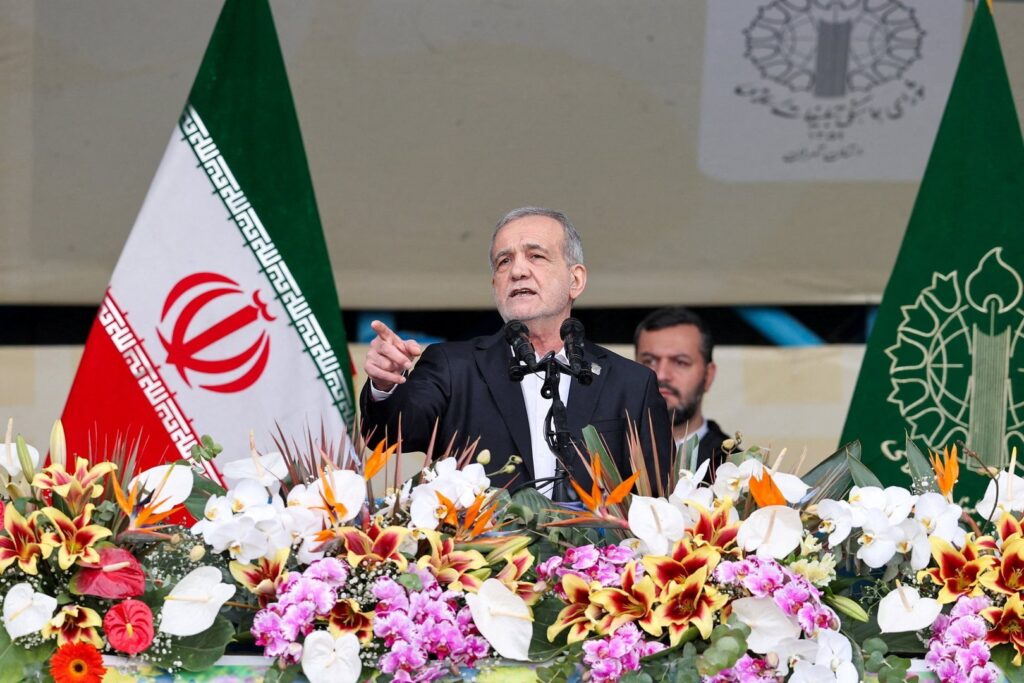
Iranian President Masoud Pezeshkian has recently addressed the country’s current geopolitical and economic situation, emphasizing Iran’s resilience in the face of ongoing challenges. Despite being under what he describes as a “full-scale war,” involving both external conflict and comprehensive sanctions, Pezeshkian asserts that Iran has not deteriorated to the level of Venezuela, a country often cited for its economic turmoil and humanitarian struggles.
Pezeshkian’s remarks come amid growing international concerns over Iran’s economic stability and political environment. While the country faces significant pressures from sanctions primarily imposed by Western nations, alongside regional conflicts impacting its security and economy, the president maintains that Iran’s institutions and society remain robust.
The comparison to Venezuela arises from the severe economic crisis and hyperinflation that Venezuela has experienced over recent years. Many analysts and commentators have drawn parallels between Iran’s current economic hardships and Venezuela’s plight. However, Pezeshkian’s statement serves as a rejection of this analogy, highlighting Iran’s distinct socio-political context and the nation’s capacity to withstand these pressures.
Iran has encountered a complex web of challenges, including intensified international sanctions aimed at its nuclear program, regional proxy conflicts, and internal economic difficulties. These factors have impacted its currency value, inflation rates, and access to foreign goods and capital. Despite these hardships, Iranian leadership emphasizes national unity, ongoing reforms, and strategic economic plans designed to stabilize and grow its economy.
The president specifically mentioned that, unlike Venezuela, Iran has not faced a total collapse of its production capabilities or banking sector. He noted ongoing government efforts to diversify the economy, boost domestic production, and reduce dependency on oil revenues.
Moreover, Pezeshkian highlighted Iran’s rich resource base, demographic strengths, and strategic geographic location as factors that contribute to its resilience. He called on Iranians to remain steadfast and cooperative with government initiatives aimed at overcoming external and internal pressures.
This stance comes as Iran continues to seek pathways to ease sanctions through diplomatic negotiations and by strengthening ties with neighboring countries and non-Western global powers. The government’s approach balances resistance with strategic engagement, aiming to secure a sustainable future for the country.
While economic indicators show strain, Iran’s leadership insists on the importance of citizen solidarity and the pursuit of self-reliance. Pezeshkian’s message encapsulates a narrative of endurance, denying that Iran’s situation mirrors Venezuela’s crisis and underscoring a confident outlook toward overcoming adversity.
As the international community watches Iran’s trajectory closely, Pezeshkian’s comments offer insight into the country’s self-perception and strategy. Iran’s ability to navigate these tumultuous waters will significantly impact not only its own future but also the geopolitical dynamics of the Middle East region.
In conclusion, despite facing what President Masoud Pezeshkian calls a “full-scale war” of sanctions and conflict, Iran asserts its strength and refuses to succumb to comparisons with Venezuela’s economic collapse. The country remains committed to forging a path forward marked by resilience, reform, and unity in the face of adversity.