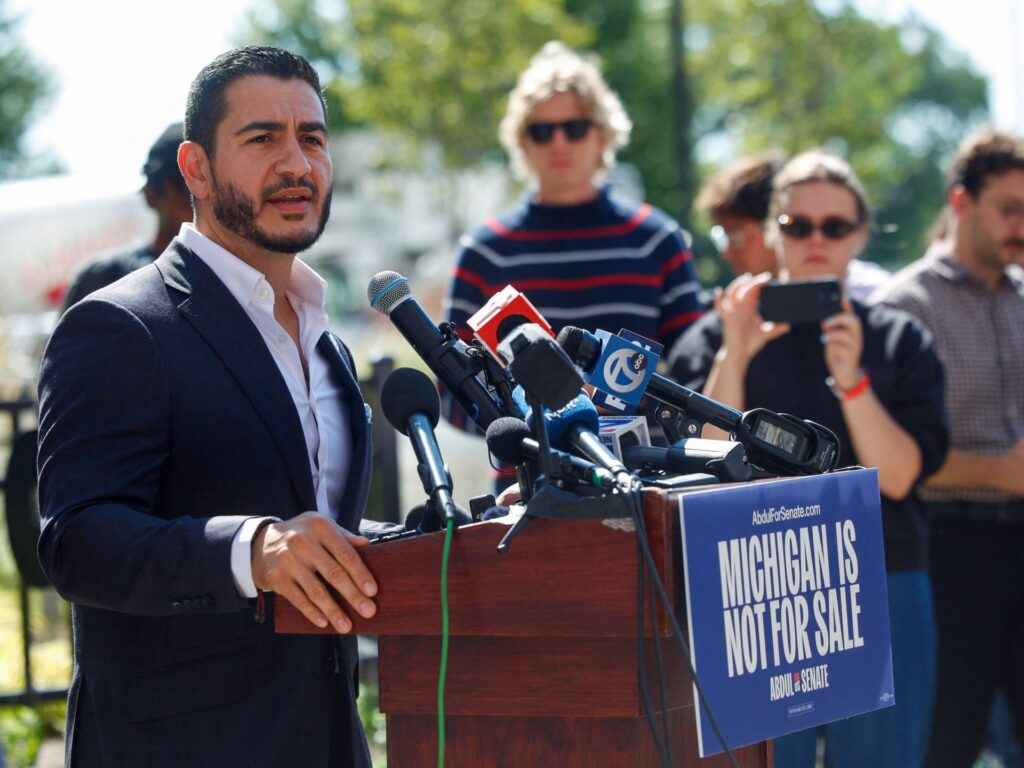
In an unexpected political upset, Michigan progressive Abdul El-Sayed secured a significant victory in the Democratic primary for the US Senate race, a win that has sent shockwaves through the pro-Israel establishment and the broader Democratic establishment alike. El-Sayed’s victory is being hailed as ‘extraordinary’ by his supporters, who see it as a bold repudiation of entrenched political interests, including influential pro-Israel lobby groups like AIPAC.
Abdul El-Sayed, a former health director of Detroit and a progressive activist, campaigned on a platform emphasizing social justice, healthcare reform, economic equality, and a nuanced approach to foreign policy that diverges from traditional Democratic stances. His campaign challenged the status quo, particularly regarding US ties to Israel, advocating for policies that many perceived as critical of the long-standing establishment consensus.
The Associated Press reported that El-Sayed had to fend off intense opposition from powerful political figures within the Democratic Party who favor maintaining a strong alliance with Israel. Many of these figures enjoy the backing of AIPAC, the American Israel Public Affairs Committee, which has long been a dominant force in shaping US policy towards Israel and influencing Democratic electoral politics.
El-Sayed’s win signals a growing appetite among Democratic voters for candidates willing to challenge traditional foreign policy orthodoxies and the political influence of lobbying groups that have shaped US Middle East policy for decades. This sentiment was reflected in the grassroots nature of El-Sayed’s campaign, which relied heavily on small-dollar donations and enthusiastic volunteer support instead of established political networks backed by large donors.
Political analysts suggest that the Michigan Senate race serves as a microcosm of the shifting dynamics within the Democratic Party, where progressives are increasingly asserting their influence and pushing for substantial policy reforms. This includes a re-examination of US-Israel relations, with debates over human rights, military aid, and the peace process gaining prominence.
Critics of El-Sayed expressed concern that his platform and criticism of pro-Israel policies could alienate key Democratic constituencies and jeopardize broader electoral success. However, El-Sayed’s supporters argue that his victory represents a necessary recalibration of political priorities, one that embraces a more inclusive and equitable approach to both domestic and international issues.
This victory is especially notable given the formidable opposition El-Sayed faced, including establishment-backed candidates who enjoyed significant financial and institutional support. The results in Michigan illustrate the power of grassroots organizing and a growing desire among voters for fresh perspectives in Washington.
El-Sayed’s success is being closely watched by progressives and political activists nationwide, who see it as a potential catalyst for broader change across the Democratic Party and US politics. It challenges the narrative that the pro-Israel establishment holds unassailable control over the party’s foreign policy positions, opening the door for more diverse voices and debates.
In conclusion, Abdul El-Sayed’s victory in Michigan’s US Senate race represents a striking shift in American politics, reflecting evolving voter priorities and a willingness to confront entrenched political interests. As progressives continue to gain momentum, the implications for US foreign policy and Jewish-American political influence could be substantial, heralding a new era of political engagement and ideological contestation within the Democratic Party.