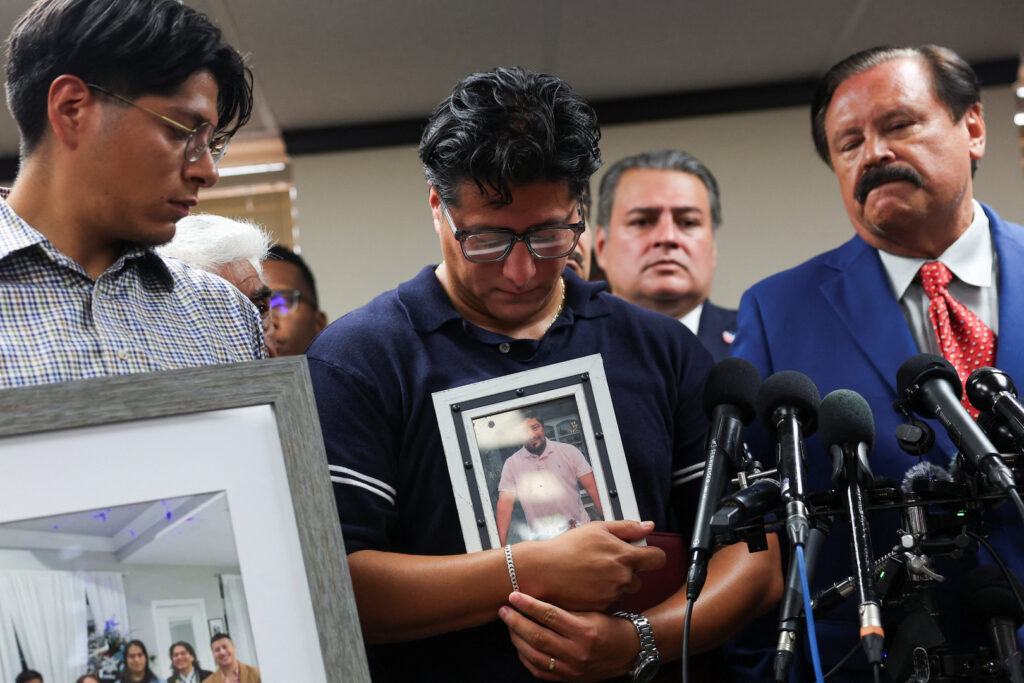
A family member holds a picture of a Mexican motorist identified as Lorenzo Salgado Araujo who was fatally shot by an ICE agent, during a news conference, in Houston, Texas, U.S., July 8, 2026. REUTERS/Antranik Tavitian
The recent tragic incident involving the fatal shooting of Lorenzo Salgado Araujo, a Mexican national, by an Immigration and Customs Enforcement (ICE) officer has sparked intense public and political discourse. Lorenzo’s son has now come forward to speak out about the circumstances surrounding his father’s death and to highlight his family’s grief and quest for justice.
Lorenzo Salgado Araujo was fatally shot during an encounter with ICE, a tragic event that has raised significant concerns about law enforcement practices and the treatment of immigrants. While ICE has maintained that the shooting was in response to an immediate threat, Lorenzo’s son disputes this version of events, emphasizing that his father posed no danger and that the shooting was unjustified.
The son described his father as a hardworking man who came to the United States seeking a better life. He painted a picture of a loving father, a committed family man, and a community member who was well-regarded by those who knew him. The unexpected and violent loss has left the family devastated and searching for answers.
Public reaction to the incident has been strong, with immigrant rights advocates and community leaders calling for an independent investigation into the shooting. They argue that such incidents highlight systemic issues in immigration enforcement and the urgent need for reforms to prevent further tragedies.
The family has expressed frustration over what they describe as a lack of transparency and accountability in the official handling of the case. They have called for the release of body camera footage and all investigative records to better understand the events that led to Lorenzo’s death.
This case has also reignited debates about ICE’s role, the conditions under which officers operate, and the protocols they follow during enforcement actions. Critics argue that violent confrontations should be avoided whenever possible, while supporters of aggressive enforcement stress the need for officer safety.
Legal experts suggest that the family may pursue civil litigation against ICE, alleging wrongful death and seeking damages. Such legal challenges, they note, could prompt broader policy reviews and potentially extra oversight of immigration enforcement agencies.
In response to the family’s statements, ICE officials have reiterated their commitment to conducting a thorough investigation and have stressed that officers are trained to use lethal force only when absolutely necessary.
The death of Lorenzo Salgado Araujo and the subsequent outcry reflect ongoing tensions and challenges in the U.S. immigration system. It underscores the human consequences of enforcement policies and the need for dialogue and reform.
As the investigation continues, the family and community await answers and hope that justice will be served. The son’s decision to speak out is a powerful plea for recognition of his father’s humanity and a call for changes to prevent others from suffering a similar fate.
This tragedy serves as a somber reminder of the complexities and high stakes involved in immigration enforcement and the vital importance of balancing security with respect for human rights.