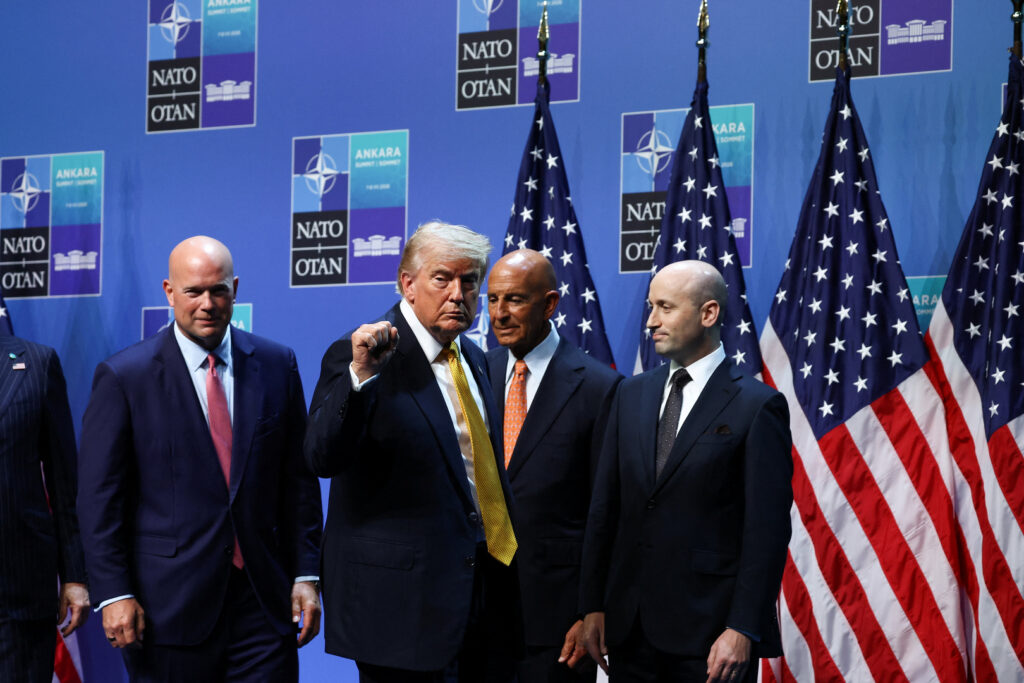
U.S. President Donald Trump gestures next to U.S. ambassador to NATO Matthew Whitaker, White House Deputy Chief of Staff Stephen Miller and U.S. Special Envoy for Syria and Ambassador to Turkey Tom Barrack as he leaves after a press conference on the day of a NATO leaders' summit in Ankara, Turkey, July 8, 2026. REUTERS/Stoyan Nenov
The United States has recently intensified its military operations against Iran, escalating tensions in an already volatile region. This development follows a stern warning from former President Donald Trump, who declared that the US would ‘hit them hard’ in response to Tehran’s actions. The escalation is rooted in accusations made by the US government, which blames Iran for violating a Memorandum of Understanding (MoU) designed to end ongoing hostilities.
The MoU, aimed at reducing conflict and fostering peace, outlined specific commitments from Iran to curtail its military activities and aggressive postures in the Middle East. However, US officials claim that Tehran has breached these terms, prompting American forces to increase their military strikes. These actions represent a significant shift in US policy and have sparked concerns about further destabilization in the region.
Iran has denied the allegations, asserting its right to defend its territory and interests. The Iranian government views the expanded strikes as provocative and a breach of international law. This latest round of military engagements marks one of the most severe escalations since the signing of the MoU.
The situation has drawn reactions from global powers, with some urging restraint and dialogue, while others support the US stance against what they describe as Iranian aggression. Regional allies of Iran have condemned the US strikes, warning of potential repercussions that could extend beyond the immediate conflict zone.
The US military has communicated that its operations target specific Iranian military installations and personnel involved in orchestrating attacks against American allies. This targeted approach aims to minimize civilian casualties while maintaining pressure on the Iranian regime to comply with international agreements.
Analysts warn that the expansion of military strikes might lead to increased instability and could trigger a wider conflict if diplomatic solutions are not pursued urgently. The international community is watching closely, with calls for renewed negotiations to prevent further escalation.
In summary, the US expansion of military strikes on Iran is a direct consequence of alleged violations by Tehran of a key MoU intended to halt warfare. This move has been explicitly supported by comments from former President Trump, signaling a tougher US policy approach. The unfolding events underscore the fragile nature of peace efforts in the Middle East and highlight the urgent need for diplomatic engagement to avoid deeper conflict.