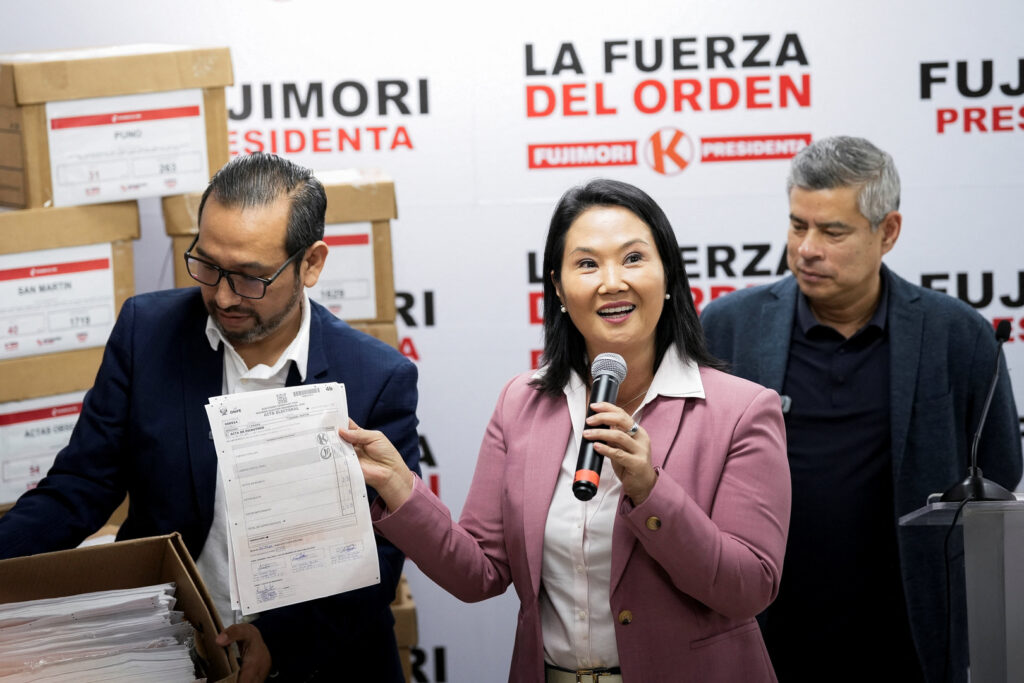
Peru’s conservative Keiko Fujimori, flanked by Luis Dyer, head of the poll watchers, and Luis Galarreta, the vice presidential candidate, holds one of the vote-counting protocols as she addresses the media at her Popular Force party headquarters after narrowly defeating leftist congressman Roberto Sanchez in Peru’s presidential election, ahead of the official announcement of the results, in Lima, Peru, June 24, 2026. REUTERS/Angela Ponce
Peru has elected Keiko Fujimori as its new president, marking a significant victory for the conservative right in Latin America. Keiko Fujimori’s triumph in the presidential election has sparked widespread attention due to the political legacy and controversies surrounding her family name. She is the daughter of Alberto Fujimori, the former president known for his authoritarian style and economic reforms in the 1990s.
Keiko Fujimori, a prominent figure in Peruvian politics for years, has campaigned on promises to strengthen the economy, improve security, and foster social development. Despite facing fierce opposition and criticism from leftist parties and activists, her platform resonated with many voters seeking stability after years of political turmoil.
In her victory speech, Fujimori emphasized unity and openness, stating that “the doors to dialogue will always be open.” She pledged to promote national reconciliation and avoid the political division that has often characterized Peru’s recent history. Many hope that her administration will steer the country towards sustainable growth and peace.
The election of Keiko Fujimori reflects a broader shift in the political landscape of Latin America, where conservative leaders have been gaining ground in countries facing economic challenges and rising crime rates. Her victory could influence regional policies, especially concerning trade, security, and international relations.
Nonetheless, Fujimori’s presidency is expected to face significant challenges. Critics remain wary due to her family’s controversial past, including allegations of corruption and human rights abuses linked to her father’s tenure. Additionally, Peru is grappling with deep social inequalities, environmental issues, and political fragmentation.
Analysts suggest that Fujimori’s government will need to balance conservative economic policies with social programs that address the needs of Peru’s diverse population. Cooperation with Congress and civil society will be crucial for implementing reforms and maintaining political stability.
Internationally, Fujimori is likely to strengthen ties with conservative governments and encourage foreign investment to boost Peru’s economy. Her stance on issues such as regional integration and climate change will be closely watched by global partners.
In summary, Keiko Fujimori’s election as president of Peru represents a pivotal moment for the country and Latin America. Her commitment to dialogue and unity signals a potential path forward, but also underscores the complexity of leading a nation with a divided past and a hope-filled future. Observers worldwide will be keen to see how her administration navigates these challenges in the years ahead.