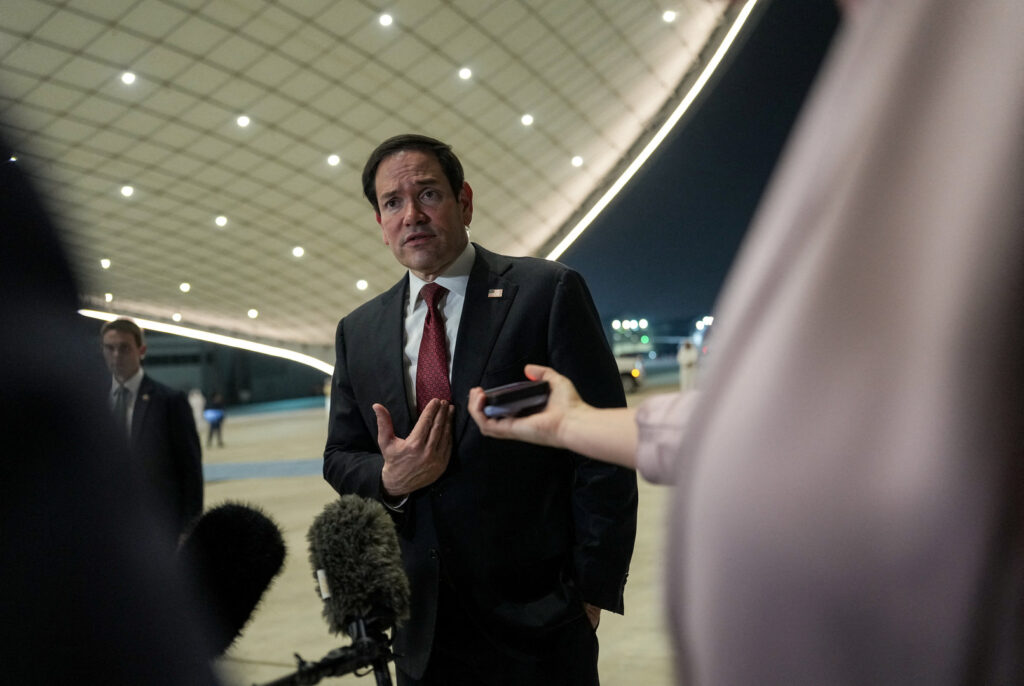
U.S. Secretary of State Marco Rubio speaks to the media upon his arrival at Al Bateen Executive Airport to discuss the interim deal between the U.S. and Iran with Arab Gulf allies, in Abu Dhabi, United Arab Emirates, June 23, 2026. REUTERS/Eric Lee/Pool
Senator Marco Rubio has commenced a significant Gulf tour with his arrival in the United Arab Emirates, aiming to rally regional support for advancing a US-Iran peace deal. This visit marks a pivotal moment in efforts to stabilize relations in the Middle East, particularly focusing on fostering cooperation between the United States and its Middle Eastern allies concerning Iran.
Rubio’s trip to the UAE is the starting point in what is expected to be a strategic outreach to Gulf states, emphasizing the importance of a unified regional stance. The US-Iran peace deal, currently a focal point of international diplomacy, seeks to address long-standing tensions by encouraging dialogue and mutual agreements on nuclear development, security, and economic cooperation.
The UAE has historically played a crucial role as a mediator in regional conflicts, and Rubio’s visit underscores its continued significance in Middle Eastern geopolitics. By engaging directly with UAE leaders, Rubio aims to solidify the partnership and ensure that Gulf countries are aligned with US objectives in negotiating the peace deal with Iran.
Rubio’s agenda includes discussions on enhancing intelligence sharing, counterterrorism efforts, and boosting economic ties among Gulf cooperation council (GCC) countries to present a consolidated front. His visit is also expected to address concerns about Iran’s regional activities, including its influence in Iraq, Syria, and Yemen.
Regional partners’ support is seen as vital for the success of the US-Iran negotiations, given the complex geopolitical landscape. The Gulf states, aware of the potential economic and security benefits from a stable Iran, are cautiously optimistic but remain vigilant about the deal’s implications.
The peace initiative, while still facing challenges, offers a pathway to reduce hostilities and open up new diplomatic channels. Rubio’s tour is likely to involve discussions on reinforcing sanctions enforcement and providing assurances that Gulf security interests are safeguarded.
As the US continues to engage in multilateral diplomacy, Rubio’s diplomatic mission is a testament to the importance of the Gulf region in shaping outcomes related to Iran. His efforts aim to bridge divides within the region and lay groundwork for durable peace.
The visit also reflects the broader US strategy to counterbalance Iran’s influence and support allies in the Gulf through robust diplomatic and security engagement. As talks progress, the role of key regional partners like the UAE will remain instrumental in the success of any agreement.
Rubio’s Gulf tour, starting in the UAE, signals a proactive American approach to Middle East diplomacy, prioritizing collaboration, stability, and the pursuit of a comprehensive peace deal that could transform regional dynamics and enhance security for all parties involved.