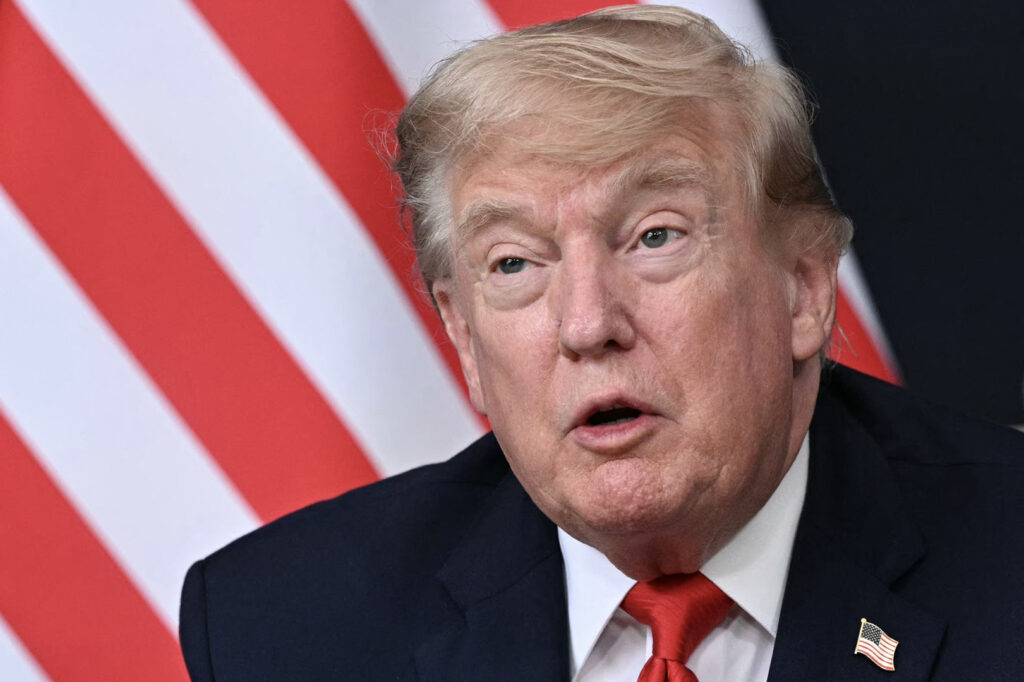
US President Donald Trump delivers remarks as he attends a bilateral meeting with UAE's President during the G7 summit, in Evian, eastern France, on June 16, 2026. A G7 summit is set to take place June 15 to 17 in the French town of Evian-les-Bains near Switzerland and it will be attended by country leaders as well as the EU's foreign policy chief and ministers from Brazil, Canada, the United Arab Emirates and Turkey. (Photo by Mandel NGAN / AFP)
At the recent G7 Summit, US President Donald Trump publicly condemned Israeli attacks on Lebanon, marking a significant stance amidst escalating tensions in the Middle East. This statement from the US leader highlights growing international concern over the conflict and its potential to destabilize the region further. During the summit, Trump emphasized the importance of peace and cautioned against actions that could exacerbate violence.
Israeli military actions in Lebanon have recently intensified, drawing widespread attention and triggering varied global reactions. Trump’s criticism is particularly notable given the traditionally strong US-Israel relations, signaling possible shifts in diplomatic approaches or an effort to balance regional interests.
The Israeli government has expressed its intent to target militant groups operating near its borders in Lebanon, citing security concerns. However, the strikes have resulted in significant casualties and damage, stirring global debates on proportionality and civilian safety.
Lebanese authorities and local populations have condemned the attacks, calling for international intervention and support. The country is already grappling with internal political challenges, and the conflict threatens to further weaken its stability.
The G7 Summit, a gathering of some of the world’s most powerful economies, serves as a platform for discussing pressing international issues, including conflicts like those in the Middle East. Trump’s remarks have sparked discussions among member states on how best to address the situation and contribute to peace efforts.
Analysts suggest that the US president’s comments may influence future international policies and diplomatic engagements in the region. There are calls for increased dialogue and restraint from all parties involved to prevent escalation into a larger conflict.
This development underscores the complex interplay of regional powers and the global community’s role in managing crises. As the situation in Lebanon evolves, the international community remains watchful, emphasizing the need for peaceful resolutions and humanitarian support.
Overall, Trump’s condemnation at the G7 signifies a critical viewpoint from a key global leader regarding Israeli military actions in Lebanon, raising hopes for renewed diplomatic efforts and cautioning against further hostilities.