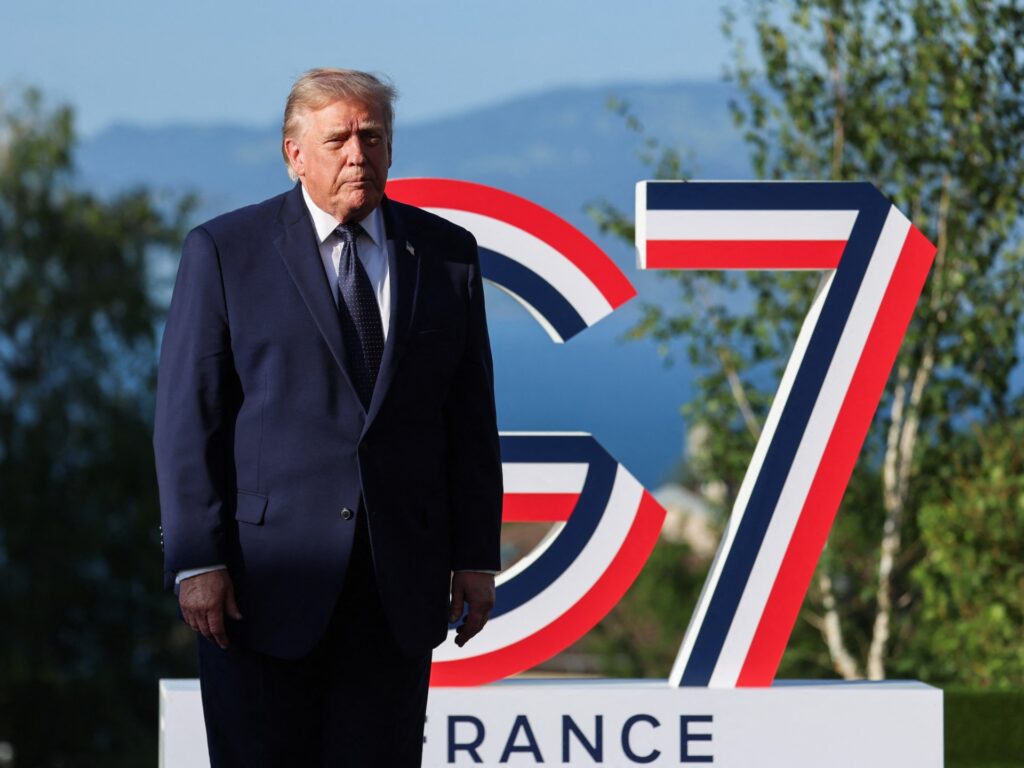
Former U.S. President Donald Trump has arrived at the G7 summit with a strong message centered on diplomacy and peace efforts. Highlighting the recent Iran nuclear deal, Trump emphasized it as a significant step towards establishing peace in the Middle East and potentially beyond.
Speaking amid ongoing global tensions, Trump praised the agreement’s potential to curb nuclear development while reducing conflict risks in the region. His optimistic outlook on the deal underscores a renewed focus on diplomatic solutions in areas long troubled by conflict.
At the G7 summit, which gathers leaders from the world’s major advanced economies, Trump also expressed ambitions to address the situation in Ukraine. While details were not extensively discussed in his opening remarks, he hinted at a strategic vision aimed at bringing stability to the war-torn Eastern European country.
The backdrop of the G7 talks has been marked by significant geopolitical challenges, including strained relations between member countries and differing approaches to handling conflicts such as the Ukraine war and Iran’s nuclear program. Trump’s statements appeared to advocate for comprehensive dialogue and negotiation over confrontation.
Observers note that Trump’s comments on the Iran deal converge with recent diplomatic efforts by other global powers to revive talks and prevent nuclear escalation. This suggests a possible shift towards more cooperative foreign policy measures, despite prevailing divisions within the alliance.
In parallel, the Ukrainian crisis remains a critical issue at the summit. Trump’s interest in Ukraine’s future stability reinforces the urgency shared by G7 members to find pathways to peace. While no new initiatives were formally announced, his remarks signal ongoing commitment to diplomatic engagement.
Critically, Trump’s approach contrasts with some more hawkish positions among other leaders, highlighting the complexities facing the G7 as it grapples with global security, economic recovery, and geopolitical rivalry.
The Iranian deal touted by Trump refers to a framework aimed at limiting Iran’s nuclear capabilities in exchange for lifting economic sanctions, a plan that has seen renewed momentum after years of stalemate. The accord is seen by some as essential to de-escalating tensions and reducing the possibility of military conflict in the strategically vital Middle East.
Meanwhile, Trump’s focus on Ukraine underscores the global repercussions of the ongoing conflict there, which has drawn international condemnation and calls for peaceful resolution. The G7 summit offers a platform for coordinating such efforts and reinforcing collective measures.
As the summit continues, leadership dynamics will play a crucial role in shaping outcomes related to peace initiatives and economic cooperation. Trump’s interventions are likely to influence discussions, especially regarding the balance between diplomatic and military strategies.
In summary, Trump arrived at the G7 summit highlighting two major geopolitical issues: the Iran nuclear deal as a step towards broader Middle Eastern peace, and ambitions to contribute to resolving the crisis in Ukraine. His comments reflect a diplomatic approach in the face of mounting international challenges, seeking pathways to stability through negotiation and cooperation.