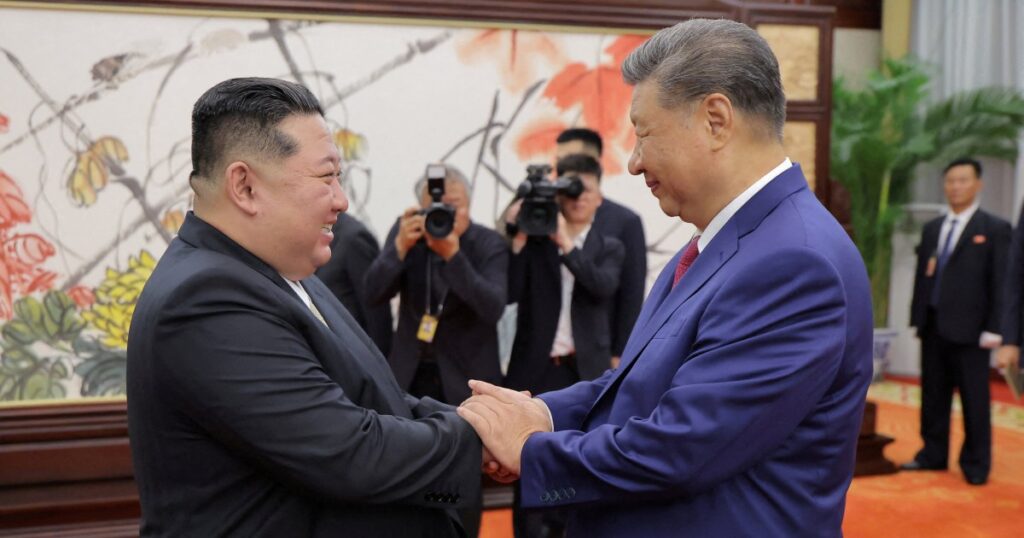
The recent visit of Chinese President Xi Jinping to North Korea marks a significant moment in the evolving geopolitical landscape of East Asia. This visit underscores the intricate relationship between the two neighbors, revealing why Beijing considers Pyongyang crucial even as North Korea depends heavily on China for its survival.
North Korea’s reliance on China is multifaceted. Economically, China is North Korea’s largest trading partner and lifeline. Due to stringent international sanctions, North Korea’s access to global markets and resources is severely restricted, making Chinese trade and aid essential for its economic stability and the sustenance of its regime. Beijing’s provision of food, fuel, and raw materials helps North Korea maintain its fragile economy.
Strategically, China views North Korea as a buffer state between itself and the U.S.-allied South Korea, where thousands of American troops are stationed. A stable North Korea helps Beijing prevent a direct border with a Western military power. Furthermore, China’s interest in preventing regime collapse in Pyongyang stems from fears of a potential refugee crisis and instability along its border.
Amid rising Pyongyang-Moscow ties, Beijing’s desire to cement its own relationship with North Korea becomes more urgent. The deepening North Korea-Russia cooperation poses a challenge to China’s influence in the region. China wants to ensure that it remains the dominant outside power guiding North Korea’s diplomatic and economic orientation.
President Xi’s visit aims to boost bilateral ties by reinforcing mutual trust and pledging economic cooperation. It signals China’s intention to maintain its strategic influence over North Korea to counterbalance Moscow’s outreach and to keep the Korean Peninsula stable under a framework favorable to Beijing.
This evolving dynamic has broader implications for regional security and global diplomacy. North Korea’s survival depends heavily on China’s patronage, but Beijing equally requires Pyongyang to maintain its security interests and geopolitical standing in East Asia. The visit symbolizes this interdependence amid shifting alliances, reflecting Beijing’s long-term strategy to secure its borders while managing complex relationships with both North Korea and other major powers.