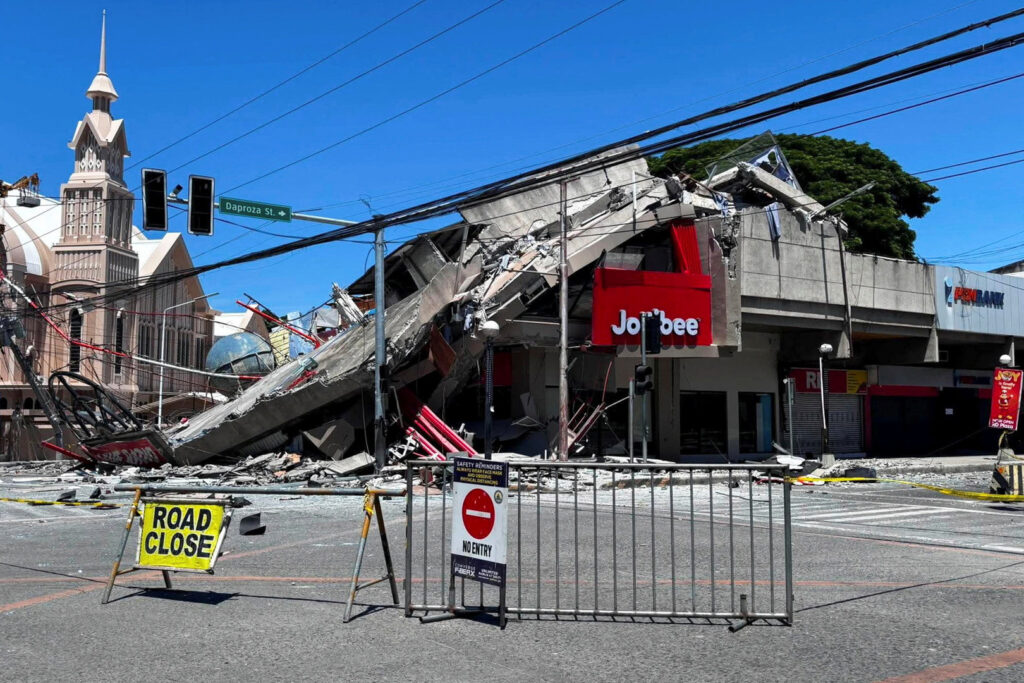
A road is blocked near the collapsed building after a magnitude 7.8 quake in General Santos, Philippines, June 8, 2026. Picture taken with a mobile phone. REUTERS/Edwin Espejo
A powerful magnitude 7.8 earthquake struck the southern Philippines, resulting in significant casualties and widespread damage. The tremor, one of the strongest to hit the region in recent years, led to the deaths of at least 15 people, with 129 others reported injured. The earthquake’s epicenter was located in a seismically active area, triggering intense ground shaking that affected multiple towns and provinces.
Emergency response teams were quickly deployed to the disaster-hit zones, focusing on search and rescue operations as aftershocks continued to rattle the area. Local authorities have declared a state of calamity in the most affected provinces, providing the government with the means to mobilize additional resources and assistance for the victims.
Residents were seen evacuating buildings amid fears of structural collapses and landslides, which are common secondary hazards during such powerful quakes. Infrastructure including roads, bridges, and communication lines suffered significant damage, complicating rescue efforts.
Health facilities reported being overwhelmed by the number of injured, as emergency services worked tirelessly to provide medical aid. Humanitarian organizations have also begun coordinating relief efforts, supplying food, water, and temporary shelter to displaced families.
Geologists warn that the region remains vulnerable to further seismic activity due to the complex tectonic interactions beneath the Philippine archipelago. Officials have urged residents to stay vigilant, prepare emergency kits, and follow guidelines issued by disaster management agencies.
The Philippine government has appealed for international support to aid in recovery and rebuilding efforts. In the meantime, local communities are coming together to recover from the devastation, demonstrating resilience in the face of natural disasters.
This tragedy highlights the ongoing need for robust earthquake preparedness measures and infrastructure improvements in seismically active regions to mitigate the effects of future events. Authorities continue to monitor the situation closely to ensure public safety and facilitate a rapid response to any further emergencies.