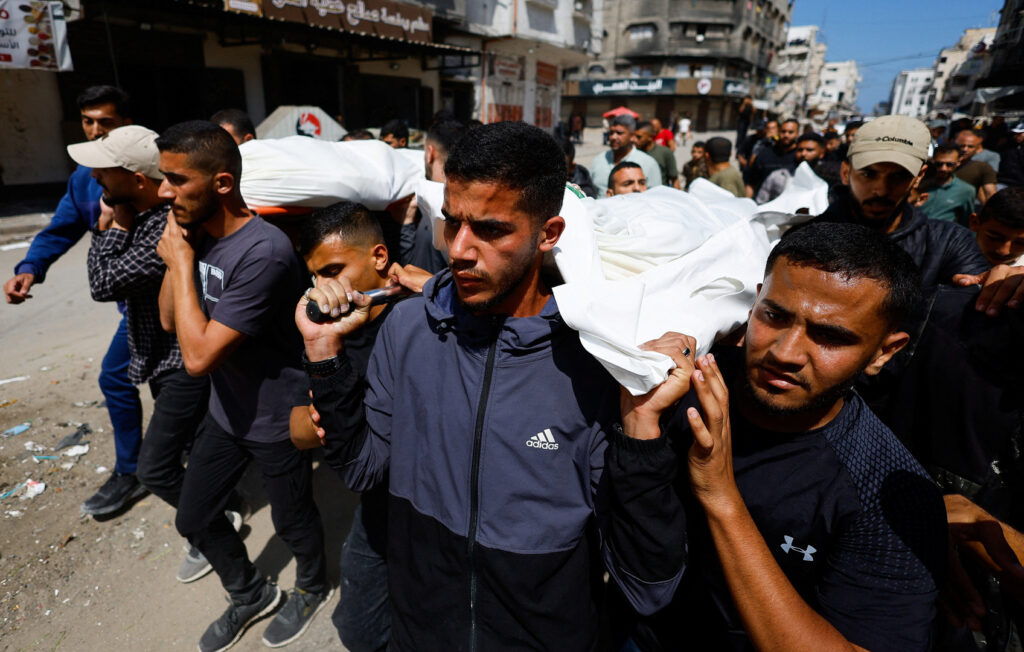
People carry bodies identified by mourners as Hamas' military wing commander Mohammad Odeh, who was killed in an Israeli strike on Tuesday, and his wife and children, during a funeral, in Gaza City, May 27, 2026. REUTERS/Mahmoud Issa
A solemn funeral was recently held for Mohammed Odeh, who is believed to have been the leader of Hamas’s military wing. The event marked a somber moment for his family as they mourned the loss of a key figure within the organization.
Mohammed Odeh’s death came amid ongoing conflict and military actions in the region, with Israeli forces targeting Hamas leadership in an effort to curb attacks and strengthen security. His role as a leader in Hamas’s military wing made him a significant target, given the group’s involvement in armed resistance and militant activities.
The funeral was attended by family members, local supporters, and representatives from the group, reflecting Odeh’s influence and standing within the movement. The loss has been publicly acknowledged by Hamas, which often mourns the passing of its leaders while reinforcing its commitment to its cause.
Hamas, designated as a terrorist organization by many countries, operates with a military wing tasked with carrying out attacks against Israeli targets and maintaining the group’s control in the Gaza Strip. The death of a leader like Odeh can have both symbolic and operational implications for the group.
In recent years, Israel has intensified its efforts to dismantle Hamas’s military capabilities, often using targeted strikes to eliminate figures considered threats to Israeli security. These operations have led to casualties among militants but also sometimes cause civilian losses, fueling cycles of tension and retaliation.
The conflict between Israel and Hamas remains highly complex, rooted in decades of political, territorial, and religious disputes. Each incident of violence, including targeted killings such as that of Mohammed Odeh, tends to exacerbate the fragile situation and prompt reactions from both sides.
The community affected by the loss of Odeh is now grappling with the ramifications and what his death means for the future dynamics within Hamas and the broader conflict. The funeral served not only as a moment of mourning but also as a platform for reinforcement of the group’s resolve.
Further details about the circumstances surrounding Odeh’s death and the strategic impact on Hamas’s military wing have yet to be fully disclosed. Analysts and officials will likely continue to monitor developments to assess potential shifts in the landscape of the ongoing conflict.
As tensions persist, the international community continues to call for restraint and seeks pathways toward de-escalation. However, incidents such as this highlight the deep-rooted challenges and the human cost of the protracted struggle between Israel and Hamas.
Mohammed Odeh’s killing is a reminder of the ongoing volatility in the region and the personal losses experienced by families involved in the conflict. His funeral signifies both an end and a continuation of the enduring disputes that shape lives on both sides of the divide.