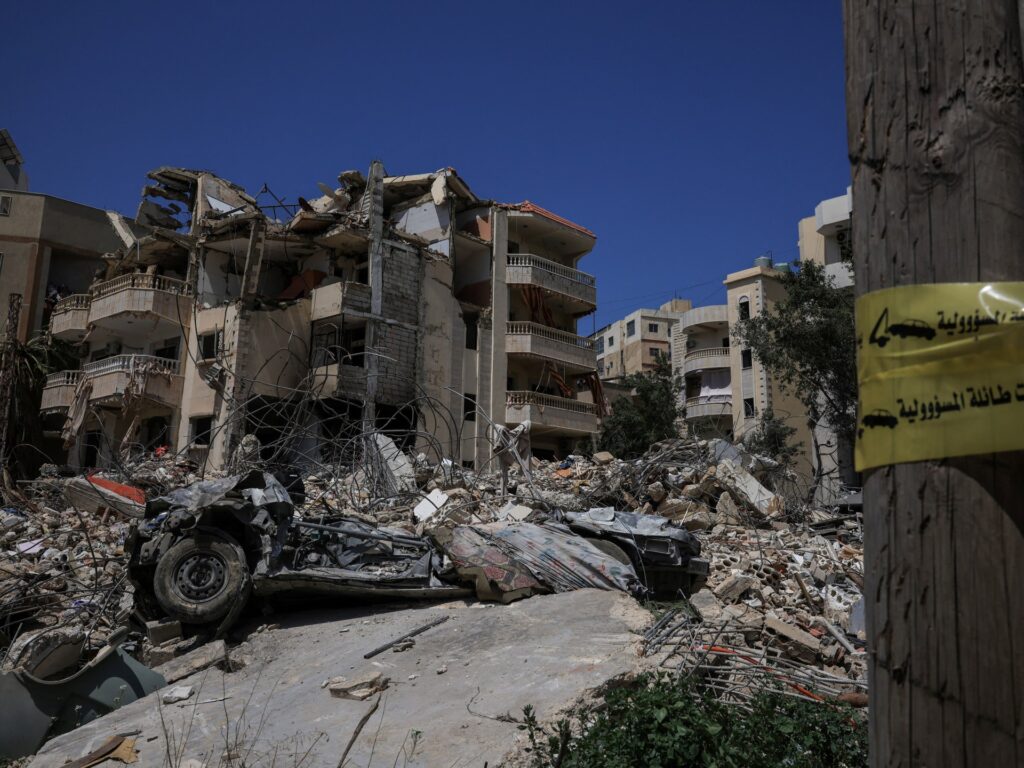
In a significant development, Israel has announced the establishment of a ‘yellow line’ in Lebanon, marking the first time such a boundary has been officially referenced in the country. This move comes after Israel implemented a similar concept in Gaza, aimed at managing and controlling escalations along its borders.
The concept of a ‘yellow line’ refers to a clearly defined boundary or limit that serves as a warning zone. Crossing this line indicates a significant escalation or a breach that could provoke a strong response from Israel’s defense forces. The aim of establishing such lines is to create a deterrent effect by signaling clear consequences for hostile actions beyond these limits.
In Gaza, the ‘yellow line’ has been a means to prevent extensive confrontations by warning militant groups and others against advancing too close to Israeli positions or carrying out aggressive activities within certain proximate distances. By applying a similar measure in Lebanon, Israel is underscoring its intention to exercise analogous control and deterrence on its northern border.
Lebanon has long been a complex arena for Israeli security concerns, primarily due to the presence of Hezbollah, a powerful Lebanese militant group and political entity. The border between Israel and Lebanon has experienced periodic flare-ups and military confrontations over the years, making stability a fragile situation.
The declaration of a ‘yellow line’ in this region signals Israel’s strategic approach to maintaining deterrence while attempting to avoid full-scale conflict. It sends a message that Israel is prepared to respond decisively if provocations or violations of this boundary occur.
Experts see this development as part of Israel’s broader security policy in the region, reflecting both an adaptation to current threats and an attempt to impose a new framework for border management. Unlike fixed borders or ceasefire lines, yellow lines function dynamically as thresholds to alert neighboring entities and prevent escalation.
From a diplomatic perspective, this move may also influence Lebanon’s internal dynamics and its relations with Hezbollah. It raises questions about how different factions within Lebanon will respond and whether this will exacerbate tensions or serve as a deterrent.
Israel’s use of the yellow line in Gaza has involved a combination of surveillance, quick response forces, and communication tactics designed to manage hostilities without necessarily triggering major military operations. Extending this concept to Lebanon suggests a strategic shift toward more nuanced border enforcement.
Security analysts note that while such lines can help manage conflict intensity, they also require careful calibration to avoid misunderstandings that could escalate into unintended clashes. The success of this policy will likely depend on Israel’s ability to maintain credible deterrence paired with diplomatic engagement and intelligence capabilities.
The international community is watching closely, as tensions in both Gaza and Lebanon have broader implications for regional stability and the ongoing Israeli-Palestinian conflict. The establishment of the ‘yellow line’ may be seen as an indicator of evolving tactics in Israel’s approach to managing its complex and often volatile borders.
In summary, Israel’s declaration of a ‘yellow line’ in Lebanon represents a new chapter in its border management strategy, modeled after measures in Gaza. It underscores the country’s effort to balance deterrence and prevention of escalation while navigating the complicated geopolitical landscape of the Middle East.