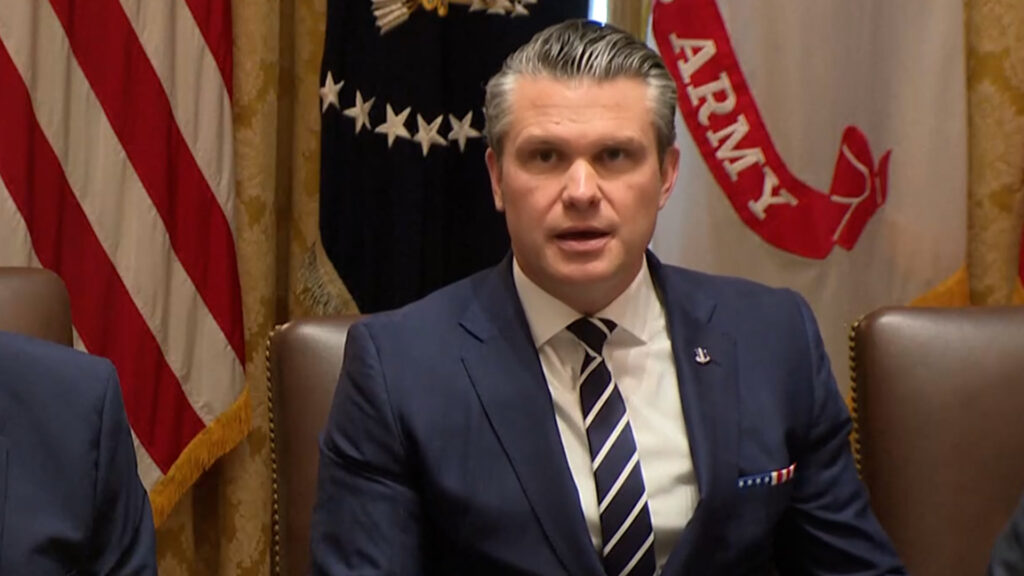
In a recent statement, Defense Secretary Pete Hegseth made a bold claim regarding Iran’s naval capabilities, asserting that Iran now possesses ‘no navy, no navy leader.’ This declaration marks a significant commentary on the shifting military landscape in the Middle East and the perceived weakening of Iran’s naval forces.
Defense Secretary Hegseth went further to characterize the concept of an ‘Iran war’ as ‘stuff for the history books,’ suggesting a diminishing likelihood of future escalations involving Iran from a U.S. or allied military perspective. His remarks come against a backdrop of ongoing tensions between Iran and the United States, especially concerning maritime security in strategic waterways such as the Strait of Hormuz.
The assertion that Iran currently lacks a navy or a naval commander is indicative of the Pentagon’s assessment of Iranian naval command structure and operational effectiveness. If accurate, it points to either internal disarray within Iran’s military hierarchy or significant degradation of its naval assets and leadership.
Iran’s navy and its paramilitary counterpart, the Islamic Revolutionary Guard Corps (IRGC) Navy, have been integral to Tehran’s strategy for asserting influence in the Persian Gulf and beyond. They have frequently been involved in incidents involving U.S. naval forces, including harassment and confrontations at sea.
However, recent U.S. defense analysis suggests that Iran’s capabilities may be overstretched or compromised due to sanctions, international pressure, or internal challenges. The claim of having no effective naval leadership raises questions about how Iran could sustain maritime operations or project power regionally.
This development follows a period of heightened scrutiny on Iran’s military developments, including its missile programs and regional proxies, but the purported erosion of its naval command structure might represent a critical vulnerability.
Experts indicate that while the Iranian Navy remains a factor in regional geopolitics, leadership instability and resource constraints could undermine its operational readiness.
Meanwhile, Secretary Hegseth’s rejection of the possibility of another war with Iran aligns with broader diplomatic efforts to de-escalate tensions and focus on containment strategies rather than direct confrontation.
This statement might also be aimed at reassuring allies and markets dependent on the stability of oil supply routes through the Gulf, signaling confidence in America’s and allied forces’ control of the maritime environment.
The Pentagon continues to monitor Iran’s activities closely, balancing deterrence with diplomatic engagement. The situation remains fluid, with geopolitical ramifications for the U.S., Iran, and the broader Middle East security framework.
In summary, Defense Secretary Pete Hegseth’s claim that Iran now has ‘no navy, no navy leader’ reflects a sharp critique of Iran’s naval military condition and signals a strong stance by the Pentagon on Iran’s diminished maritime threat. Coupled with his comments about the Iran war being ‘stuff for the history books,’ these declarations emphasize a current period of strategic reevaluation and potential military recalibration in U.S. policy toward Iran.