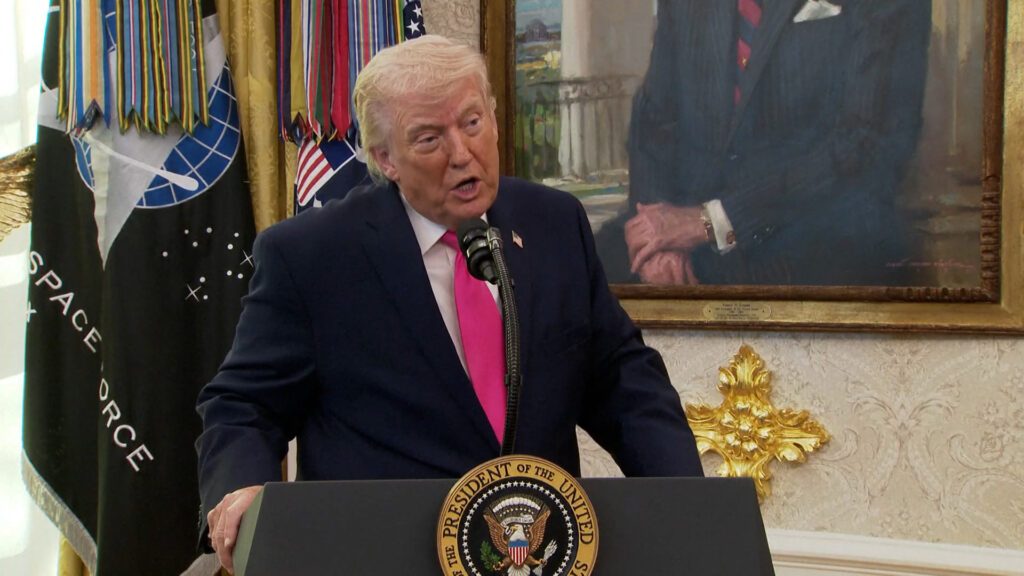
In a recent and notable development, US President Donald Trump announced from the Oval Office that the United States has successfully achieved regime change in Iran. This assertion marks a significant moment in the ongoing geopolitical tensions between the two countries.
During a press interaction, President Trump stated that the US has effectively brought about a shift in the political landscape of Iran. He described this turn of events as receiving a ‘present’ from Iran, suggesting that the outcome was, in some manner, facilitated by recent actions or developments related to Iranian leadership or policies.
This claim of regime change is significant given the history of complex and often strained relations between the US and Iran. For decades, diplomatic ties have been marked by ideological conflicts, economic sanctions, and opposing geopolitical ambitions in the Middle East.
President Trump’s remarks have sparked widespread attention and analysis from political analysts, diplomats, and international observers. The nature of the regime change, its specifics, and the mechanisms through which it was achieved have not been immediately clarified by the White House. However, the statement implies a substantial shift in Iran’s leadership or governance structures that align with US strategic objectives.
The term ‘regime change’ typically refers to the replacement of a government, often through external intervention or pressure. In this context, the suggestion that the US has achieved such a change could indicate a broader strategy aimed at weakening Iran’s current ruling establishment and altering its influence in the region.
Iran has been a central player in Middle Eastern politics, with significant influence over neighboring countries and involvement in various regional conflicts. The US goal of modifying Iran’s regime may be motivated by concerns over nuclear proliferation, support for militant groups, or ideological opposition to theocratic governance.
The characterization of the outcome as a ‘present’ also hints at an element of surprise or an unexpected advantage gained by the US. This could relate to recent diplomatic developments, internal Iranian political shifts, or outcomes from other international pressures such as sanctions or military actions.
The international community has been closely monitoring developments in Iran, particularly regarding its nuclear program and regional policies. President Trump’s announcement adds a new dimension to these ongoing concerns, underscoring potential shifts in power dynamics.
Iranian officials and state media responses to the US claim have been cautious but defiant. They typically reject accusations of surrender or collapse, emphasizing national sovereignty and resistance to foreign intervention.
Despite the boldness of the claim, the full implications remain unfolding. Analysts stress the importance of observing how Iran’s domestic politics evolve and how neighboring countries react to these changes.
The situation is likely to influence global diplomatic relations, economic sanctions regimes, and security considerations in the Middle East and beyond.
In summary, President Donald Trump’s announcement that the United States has achieved regime change in Iran, and has ‘received a present’ from the country, represents a significant statement with wide-reaching implications. The details and long-term effects of this development will continue to be a focal point for international observers and policymakers in the near future.