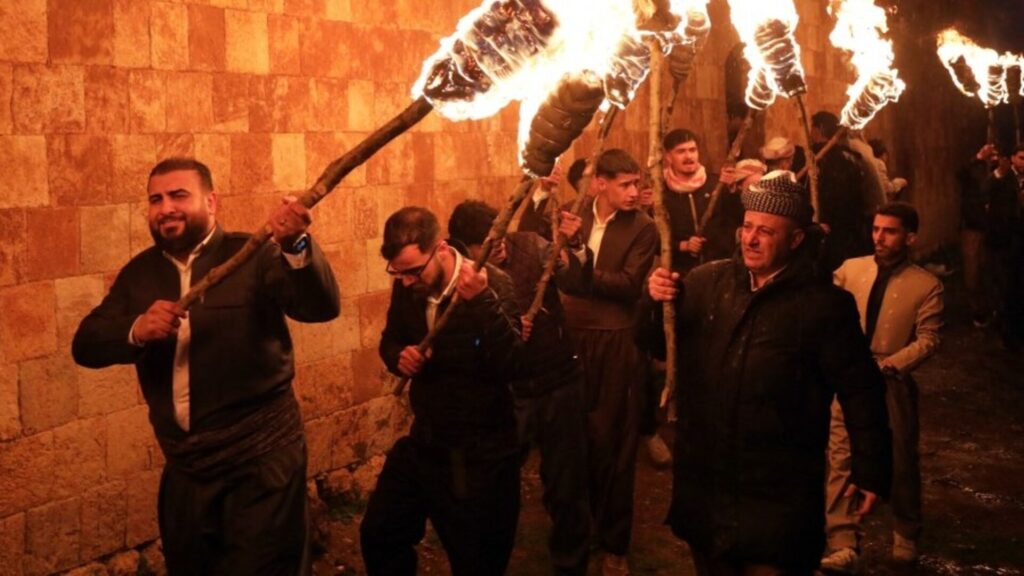
Iraqi Kurds march with torches during a procession to celebrate the Nowruz New Year festival in the town of Akre, about 100 kms north of Arbil, in Iraq's northern autonomous Kurdish region on March 20, 2026. Millions of people across the Middle East, Asia and Eastern Europe celebrate Nowruz new year festival, which marks the start of spring. (Photo by Safin HAMID / AFP)
Nowruz, the ancient Persian New Year, is celebrated by over 300 million people worldwide, marking the arrival of spring and symbolizing renewal and hope. This year, however, the joyous festivities took place under the somber shadow of ongoing conflict in the Middle East.
Despite the turmoil, millions have come together to honor traditions that date back over 3,000 years. Families and communities gather to set the Haft-Seen table, a symbolic arrangement featuring seven items beginning with the Persian letter ‘S’, each representing hopes for the new year such as health, prosperity, and love.
The enduring nature of Nowruz celebrations during wartime highlights the resilience of cultural identity amidst adversity. From bustling cities to remote villages, people have continued to perform rituals including visits to friends and relatives, traditional dances, and the sharing of festive meals.
In countries affected by conflict, such as Iran, Iraq, Syria, and parts of Afghanistan, the celebration of Nowruz becomes an act of defiance against hardship. It serves as a reminder of unity and the inherent human desire for peace and better days ahead.
International communities and diasporas also joined in the celebrations, using the occasion to raise awareness about the impact of war on civilians. Cultural organizations have adapted events new formats, combining virtual platforms with physical gatherings to maintain tradition while promoting safety.
Religious and political leaders, as well as activists, have used the Nowruz platform to call for ceasefire and dialogue, emphasizing the spirit of rejuvenation intrinsic to the holiday. Messages of hope resonate across social media and public speeches, inspiring many to envision a future beyond conflict.
Educational programs during Nowruz have focused on the shared heritage of the region’s diverse peoples, fostering understanding and tolerance. This cultural emphasis aims to counteract the divisive forces of war and support reconciliation efforts.
In the face of loss and displacement caused by violence, the symbolism of Nowruz—rebirth and new beginnings—has gained profound significance. It bolsters the morale of communities enduring hardship and solidifies the collective will to rebuild.
As 300 million people celebrate Nowruz globally, the festival’s persistence is a powerful testament to human endurance and hope. It reminds the world that even amid war, the desire for peace and cultural continuity remains strong.
In summary, Nowruz 2024 emerges as both a celebration and a call to conscience. It bears witness to the strength of cultural traditions that survive in spite of conflict and highlights the universal yearning for harmony that transcends borders and politics. Through Nowruz, millions affirm life, revival, and peace—principles vital for healing a war-torn region and inspiring a hopeful new year.