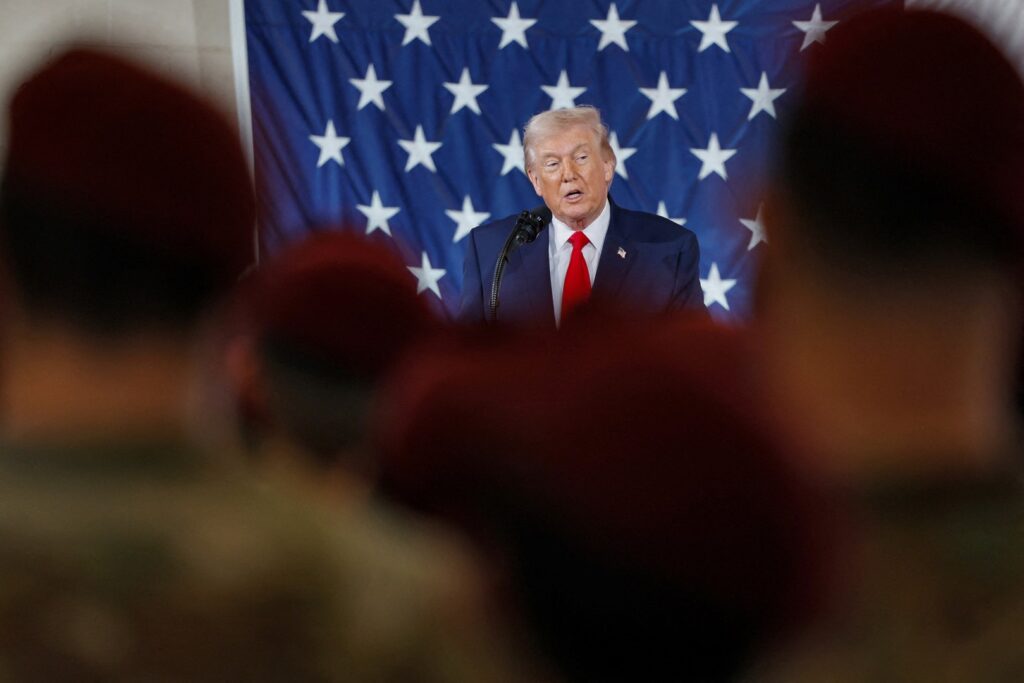
U.S. President Donald Trump delivers remarks to military families, in Fort Bragg , North Carolina, U.S., February 13, 2026. REUTERS/Jonathan Drake
In a significant escalation of the United States’ military presence in the Middle East, President Donald Trump has announced the deployment of a second aircraft carrier strike group to the region. This move underscores the administration’s commitment to safeguarding American interests and enhancing security in a strategically critical area.
The decision to send an additional carrier strike group comes amid rising tensions and ongoing conflicts in the Middle East. Aircraft carriers are pivotal assets for power projection, allowing the U.S. Navy to conduct air operations far from home shores, provide rapid response capabilities, and support joint military endeavors with allies.
The deployment will bolster the existing carrier strike group already operating in the region, effectively doubling the naval aviation force available to address potential threats. This enhanced presence aims to deter hostile actions from adversaries, provide reassurance to regional partners, and maintain freedom of navigation in vital waterways such as the Strait of Hormuz.
President Trump emphasized that the deployment is not intended to provoke conflict but rather to ensure that the United States is prepared to defend its interests and respond swiftly to any escalation. The administration highlighted concerns over Iran’s activities in the region and the need for a robust posture to counterbalance regional instability.
Military analysts note that the addition of a second carrier strike group significantly increases the U.S. Navy’s operational flexibility and reach. Aircraft carriers bring along a powerful air wing capable of launching fighter jets, surveillance planes, and electronic warfare assets—all crucial elements in modern naval warfare.
The announcement was made following consultations with senior military leaders and advisers who recommended reinforcing the U.S. presence to deter aggression and protect vital energy routes. The Middle East continues to be a focal point of geopolitical tensions, with several ongoing conflicts and power struggles that impact global security and economic stability.
Critics of the move caution that an increased military footprint could escalate tensions and potentially draw the U.S. deeper into regional conflicts. They argue that diplomatic efforts should be prioritized to de-escalate the situation and avoid the risk of unintended confrontations.
In response, White House officials stated that the deployment is part of a balanced strategy that includes diplomatic engagement, economic measures, and military readiness. The additional carrier strike group aims to provide a credible deterrent while supporting diplomatic initiatives.
The deployment timeline for the second carrier strike group has not been precisely disclosed, but it is expected to occur in the near future, reinforcing the U.S. naval capabilities in the Persian Gulf and surrounding areas. The operation exemplifies the strategic importance of naval power in securing American interests and promoting stability in volatile regions.
The presence of two carrier strike groups in the Middle East marks a notable shift in U.S. military posture, reflecting concerns about increased threats and the need for decisive actions to maintain regional balance. This development will be closely monitored by international observers and regional actors, who recognize the implications for security dynamics.
Overall, President Trump’s order to send a second aircraft carrier strike group to the Middle East highlights the administration’s intent to adopt a proactive approach to security challenges in the region, leveraging the full spectrum of military capabilities to protect American and allied interests.