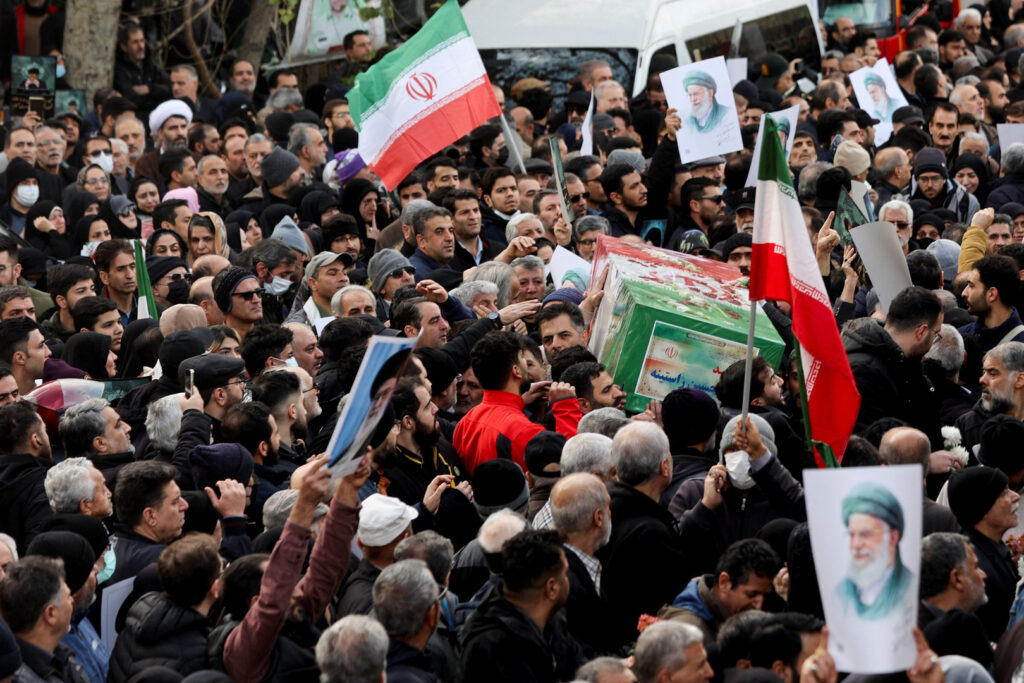
People attend the funeral of the security forces who were killed in the protests that erupted over the collapse of the currency's value in Tehran, Iran, January 14, 2026. Majid Asgaripour/WANA (West Asia News Agency) via REUTERS ATTENTION EDITORS - THIS PICTURE WAS PROVIDED BY A THIRD PARTY
Tensions between Iran and the United States continue to simmer, with recent developments causing concern in the geopolitical landscape of the Middle East. Tehran has reopened its airspace, a move closely watched by global powers, as the US has begun withdrawing some personnel from its airbase in Qatar.
The reopening of Iran’s airspace marks a significant shift in regional dynamics. Previously, certain restrictions had contributed to strained relations and complicated diplomatic engagements between Iran and Western countries. The decision by Tehran to allow air traffic again could be interpreted as a strategic signal amid escalating regional tensions.
Simultaneously, the US military’s decision to reduce its presence at the Al Udeid Air Base in Qatar has raised alarms in the region. The base, vital for US operations in the Middle East, serves as a key hub for surveillance, logistics, and rapid deployment capabilities.
US officials have stated that the drawdown is a strategic recalibration rather than a full withdrawal, aimed at redistributing forces to other areas deemed critical for US interests. However, analysts fear that this reduction could embolden Iran to assert more aggressive postures in the Gulf and beyond.
Iran’s government has not officially commented on the US troop movements, but Iranian state media have portrayed the reopening of airspace as a sovereign right and an assertion of national strength. The move is being closely monitored by neighboring countries who share complex ties with both Iran and the US.
The reopening of Tehran’s airspace also has implications for international airlines and commerce. With Iran positioned at the crossroads between Asia and Europe, air routes are vital for global trade and travel. Airlines are cautiously adjusting their flight paths in response to the geopolitical shift.
Meanwhile, tensions have manifested in verbal exchanges and diplomatic warnings. US officials have reiterated their commitment to protecting their interests and allies in the region. Conversely, Iran has made statements warning against any perceived acts of aggression or interference in its sovereign affairs.
The broader context includes ongoing disputes over Iran’s nuclear program, regional militia activities, and sanctions that continue to shape US-Iran relations. The reopening of airspace comes at a time when dialogue between the two nations remains limited and fraught with suspicion.
Regional experts suggest that the situation remains volatile, with the potential for rapid escalation if either side miscalculates actions or intentions. The international community, including European and Middle Eastern nations, calls for restraint and diplomatic engagement to reduce the risk of conflict.
In conclusion, Iran’s reopening of its airspace amid US troop withdrawals in Qatar highlights the fragile and complex nature of Middle Eastern geopolitics. It underscores ongoing strategic calculations by both Tehran and Washington as they navigate a tense and uncertain security environment. Stakeholders worldwide will be watching closely as events develop, hoping for stability but preparing for possible challenges ahead.