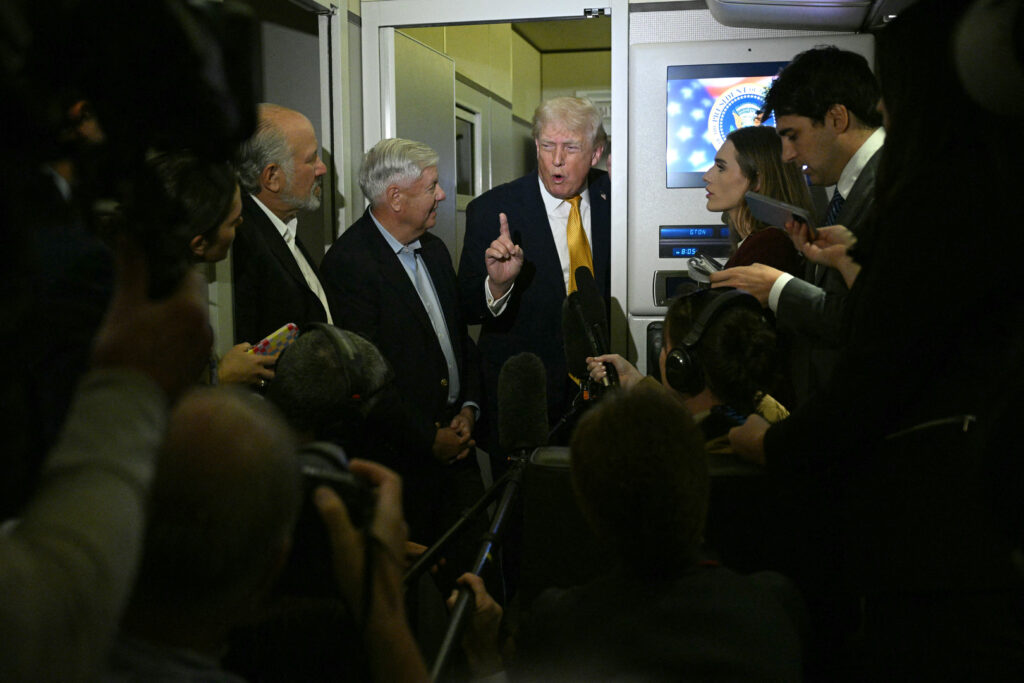
US President Donald Trump (C-R), accompanied by US senator Lindsey Graham, Republican of South Carolina, speaks with reporters aboard Air Force One on his way back to Washington, DC, on January 4, 2026. President Trump is returning to DC after spending the holidays at his Mar-a-Lago residence in Palm Beach, Florida. (Photo by Jim WATSON / AFP)
In a recent escalation of political tensions in Latin America, former US President Donald Trump has issued a direct threat to Colombia’s president. This development comes in the wake of the United States’ controversial abduction of Venezuelan leader Nicolas Maduro, an event that has intensified diplomatic strain across the region.
Donald Trump’s remarks not only targeted Colombia’s leadership but also included an assertive statement regarding Cuba, suggesting that the island nation is “ready to fall.” This rhetoric signals a heightened posture from Trump concerning US influence and interests in Latin America.
The abduction of Nicolás Maduro, which remains a contentious and heavily disputed operation, has drawn sharp international criticism and complicated diplomatic relationships. Colombia, a key US ally, now finds itself enmeshed in a precarious situation as it faces direct scrutiny from the former US commander-in-chief.
Trump’s message arrives at a sensitive time when the political climate in South America is already volatile. Colombia’s government has so far maintained a cautious stance amid the unfolding events, balancing its alliance with the United States and its regional relations.
The statement also amplifies tensions surrounding Cuba, a socialist nation that has long been at odds with US policies. By claiming Cuba is “ready to fall,” Trump is insinuating a potential collapse or significant change in the Cuban government’s status, hinting at possible future US actions or a shift in regional dynamics.
Observers are closely monitoring these developments, as they could presage further interventionist policies by US-affiliated actors in Latin America. The situation raises questions about the future of US-Latin America relations and the potential impacts on regional stability.
This incident reflects broader geopolitical struggles involving Venezuela, Colombia, Cuba, and the United States, with each country involved navigating complex alliances and conflicts. The implications of such threats and aggressive posturing could lead to increased instability if not addressed through diplomatic channels.
In the context of Latin American politics, where national sovereignty and foreign influence often clash, Trump’s statements highlight the delicate balance of power and the ongoing contest for influence within the hemisphere.
As tensions rise, the international community is urged to seek peaceful resolutions and uphold diplomatic norms to prevent further escalation that could affect millions across Latin America.
In summary, Donald Trump’s recent threats to Colombia’s president and his provocative statements about Cuba underscore a period of heightened uncertainty and potential conflict in the region. How Colombian authorities respond and how Cuba navigates this pressure will be crucial in shaping the geopolitical landscape in the months ahead.