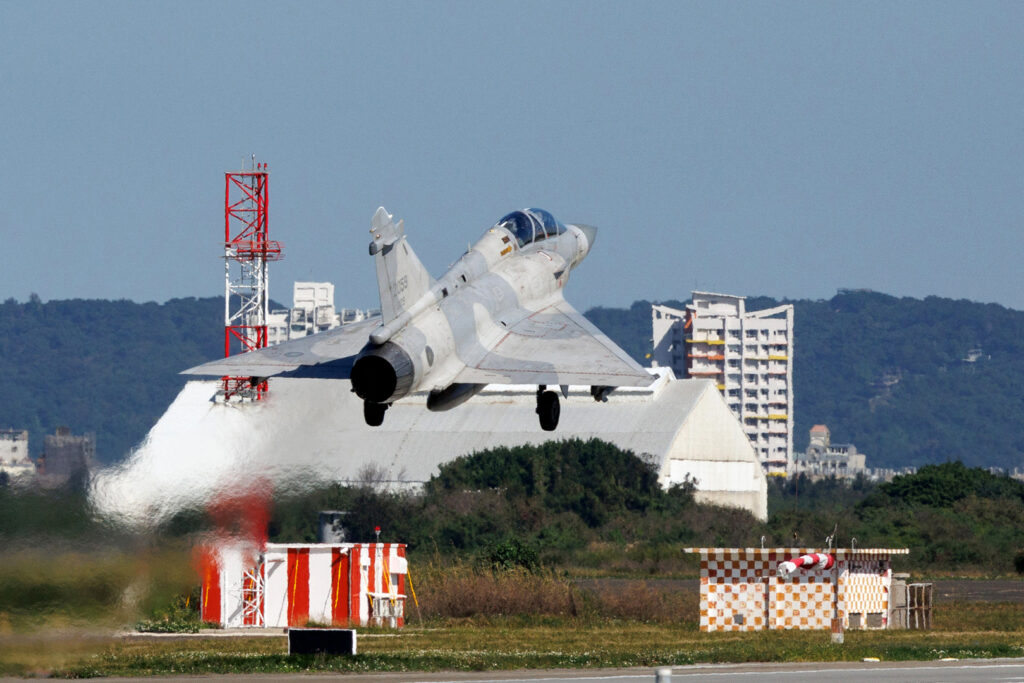
A Taiwan Air Force Mirage 2000 fighter jet takes off at Hsinchu Air Base in Hsinchu on December 29, 2025. China launched "major" military exercises around Taiwan on December 29, in what it called a "stern warning" involving live-fire drills in waters and airspace near the island. Taiwan said Monday it had detected four Chinese coastguard ships near the island's waters. (Photo by CHENG Yu-chen / AFP)
China has initiated extensive live-fire military exercises around Taiwan, marking a significant escalation in regional tensions. These two-day exercises are designed by Beijing to simulate a blockade of key Taiwanese ports, underscoring China’s intent to demonstrate its military capabilities and assert its claim over Taiwan.
The drills involve various branches of the Chinese military, including naval, air, and missile forces, highlighting the comprehensive nature of the operations. The exercises aim to practice and perfect strategies that could be employed in the event of a conflict or blockade scenario, signaling China’s readiness to exert pressure on Taiwan.
Taiwan, a self-governed island that China considers a breakaway province, has condemned the exercises as provocative and destabilizing. Taipei views these maneuvers as a direct threat to its sovereignty and security, raising alarm among its citizens and international allies.
The live-fire exercises are taking place in waters surrounding Taiwan, encompassing key maritime routes crucial for Taiwan’s trade and supply lines. China’s simulated blockade aims to demonstrate the potential to disrupt these vital channels, which would have significant economic and strategic consequences for Taiwan and the broader Indo-Pacific region.
Internationally, the exercises have drawn widespread concern. Many countries, including the United States and its allies, have called for restraint and urged Beijing to engage in dialogue rather than military posturing. The United States, which maintains unofficial ties with Taiwan and is bound by the Taiwan Relations Act to support the island’s defense capabilities, has criticized the drills as destabilizing to regional peace.
Analysts interpret China’s actions as a show of strength and a warning against what it perceives as increasing foreign interference in Taiwan affairs. The situation highlights the complex and volatile nature of cross-strait relations, which remain one of the most sensitive geopolitical flashpoints.
The Taiwanese government has responded by heightening its military readiness and coordinating with international partners to ensure security and stability in the region. Taiwan’s armed forces are conducting their own drills and are on alert to respond to any potential escalation.
The exercises come amid broader geopolitical tensions in the Indo-Pacific, where China’s growing influence is increasingly challenging the established order. The developments around Taiwan are a critical test of the international community’s ability to manage conflict and uphold the principles of sovereignty and peace.
In conclusion, China’s live-fire military exercises around Taiwan represent a significant escalation in cross-strait tensions, with potential ramifications for regional security and global diplomacy. The coming days will be closely watched to assess the impact of these maneuvers and the responses from Taiwan, its allies, and the international community.