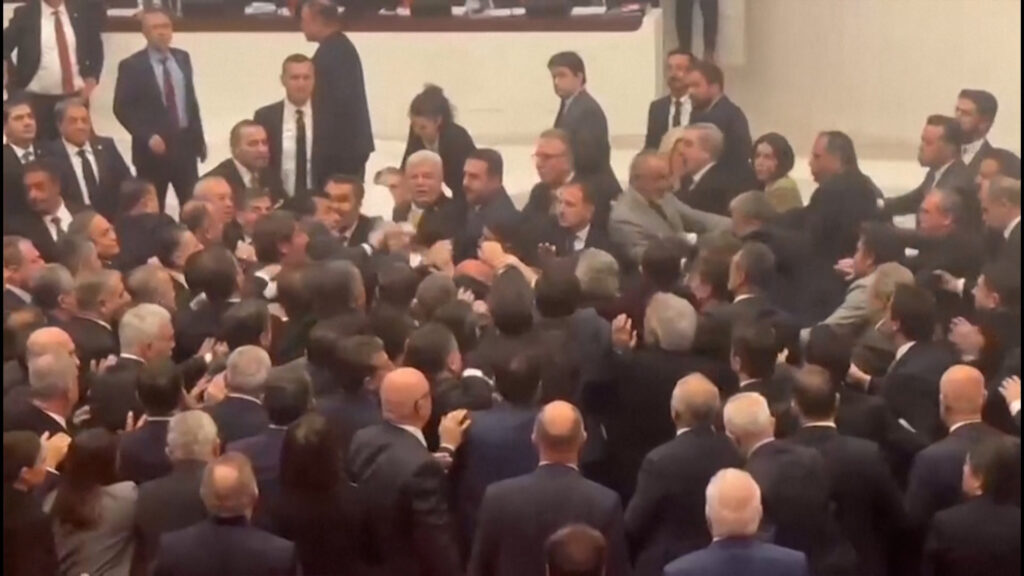
A violent brawl erupted within the Turkish Parliament on the last day of the crucial budget discussions, highlighting the intense political tensions between the ruling AK Party and the opposition CHP. The confrontation disrupted the legislative process and underscored the deep divisions within Turkiye’s political landscape.
The incident occurred as both parties debated the national budget, which is a critical aspect of economic planning and governance. Members of the AK Party and CHP exchanged heated words that escalated into physical altercations, forcing parliamentary proceedings to a halt. Security personnel intervened to restore order, but the incident left a significant mark on the political atmosphere.
This clash is emblematic of growing polarization in Turkiye’s political arena. The AK Party, which has held power for years, and the CHP, its main opposition, have frequently been at odds over not only budgetary issues but broader policy directions and governance strategies.
Observers note that such disruptions can hinder effective legislative work, delay important policy implementations, and impact public confidence in the government. The budget discussions are especially vital this year, given regional economic challenges and the need for financial stability.
Both parties have invoked strong narratives to justify their actions, with the ruling AK Party accusing the opposition of obstructing governance, while the CHP criticizes alleged authoritarian tendencies within the ruling party.
The brawl also reflects broader social and political frustrations, as citizens watch their representatives struggle to find common ground amidst disagreements.
Political analysts warn that such confrontations, if frequent, might deepen divides and reduce opportunities for consensus-based policymaking. They advocate for dialogue and negotiation to overcome partisan conflicts.
As economic pressures mount globally, the stability and effectiveness of parliamentary proceedings become increasingly critical. The incident serves as a wake-up call to all political stakeholders about the need to prioritize the nation’s welfare over partisan conflicts.
Many hope that lessons are learned from this episode, and that future parliamentary sessions will focus on constructive debate rather than discord. Political leaders are urged to demonstrate maturity and commitment to democratic principles.
The Turkish public remains watchful, anticipating that their elected officials will rise above divisions to serve the country’s best interests, particularly in times of economic uncertainty.
This event also draws international attention to Turkiye’s political climate, raising questions about governance and democratic resilience in the region.
Ultimately, the brawl in parliament on the last day of the budget talks is a stark reminder of the challenges in balancing political competition with constructive governance. The path forward requires cooperation, respect, and a shared vision for Turkiye’s future.