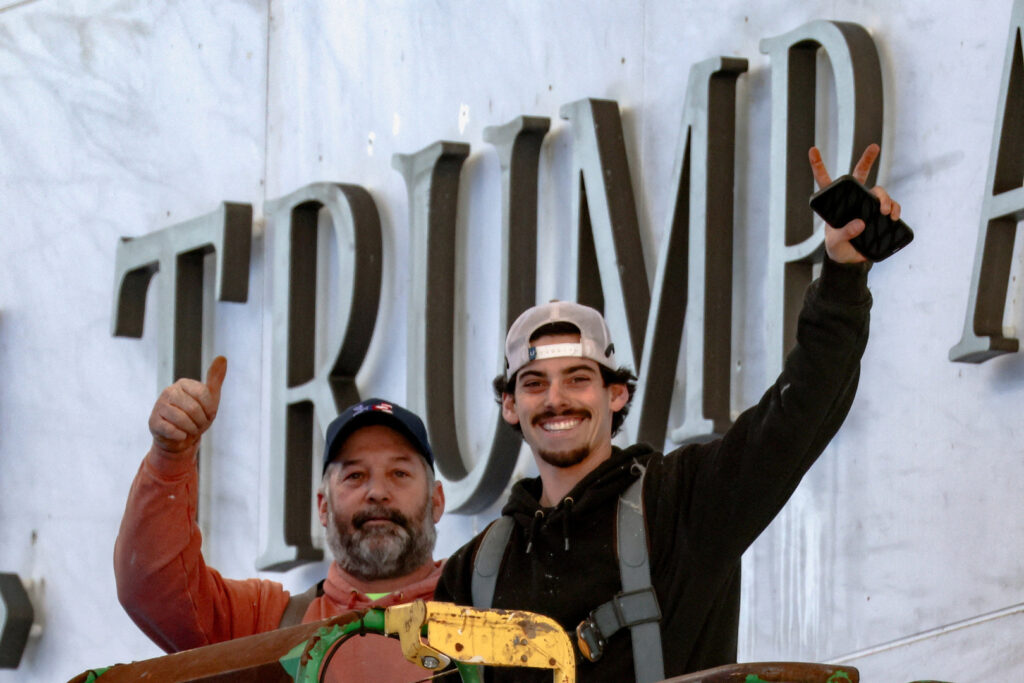
Workers react to media watching the installation of U.S. President Donald Trump's name in the facade of the John F. Kennedy Center for the Performing Arts, a day after its board announced it would rename the institution The Donald J. Trump and The John F. Kennedy Memorial Center for the Performing Arts, in Washington, D.C., U.S., December 19, 2025. REUTERS/Kevin Lamarque TPX IMAGES OF THE DAY
In a notable change at one of America’s premier cultural institutions, President Donald Trump’s name has been added to the facade of The John F. Kennedy Center for the Performing Arts. This move has led to the venue being informally referred to as the ‘Trump-Kennedy Center’ since the addition.
The John F. Kennedy Center, named after the late President John F. Kennedy, has long been a symbol of the nation’s dedication to the arts and serves as a home for a diverse array of performing arts including theater, dance, and musical performances. The decision to feature President Trump’s name prominently on such a historic venue marks a significant moment in the center’s history and public perception.
This renaming or addition is part of a broader trend where names of prominent figures, particularly political leaders, are attached to public landmarks and institutions, often sparking discussions and debates about legacy, honor, and the intersection of politics and culture.
Supporters argue that the inclusion of President Trump’s name acknowledges his contributions or influence during his administration, potentially tied to funding, policies, or initiatives that benefited the arts and cultural sectors. They see this gesture as a recognition of his impact on national institutions and the arts community.
Conversely, critics of the move see it as politicizing a cultural landmark, warning that the decision could overshadow the center’s original dedication to President Kennedy and its purpose as a unifying place for people from all walks of life to enjoy the arts.
The Kennedy Center has historically been a politically neutral ground, hosting performances and events that celebrate a wide range of cultural expressions from across the country and the world. The addition of a sitting or recent president’s name can evoke mixed reactions from the public, staff, artists, and patrons.
This change comes amidst broader national conversations about how public spaces and memorials are named and the legacies that these names carry. Many institutions have faced similar debates and decisions, reflecting the evolving landscape of American culture and politics.
The Kennedy Center’s administration has not released detailed statements about the reasoning behind this name addition, leaving some to speculate about the motives or future plans for the venue. Observers anticipate further discussion and possibly more changes in how the center presents itself and its mission.
As the ‘Trump-Kennedy Center’ designation begins to enter public discourse, it remains to be seen how this will affect attendance, programming, and the center’s role in the cultural life of the nation. It also raises questions about how the arts can continue to serve as a bridge across political and social divides in a polarized environment.
Regardless of opinions, the addition of President Trump’s name to the Kennedy Center’s facade is a historic development, highlighting the complex interplay between politics, culture, and legacy in America. It underscores the enduring significance of names and symbols in shaping collective memory and identity.
Going forward, the Kennedy Center may find itself at the center of both cultural celebration and political conversation, reflecting the dynamic nature of public institutions and their ongoing evolution amidst changing societal values and leadership.