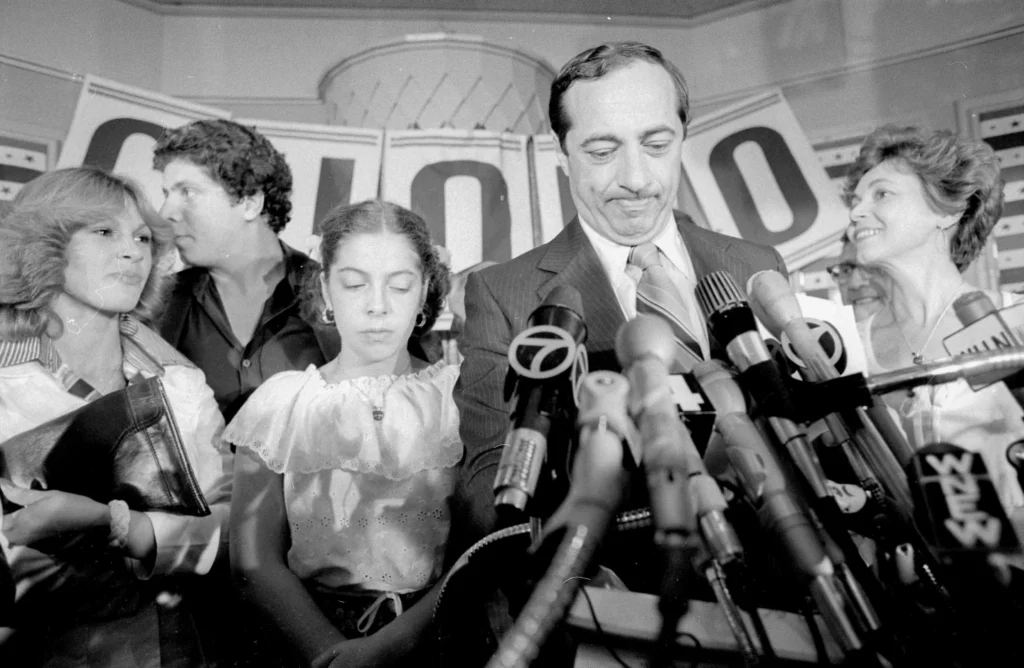
NEW YORK— In 1977, at the tail end of another bruising battle for New York City mayor, Mario Cuomo publicly spoke up against bigoted remarks leveled at his opponent. Almost 50 years later, his son is taking a different approach.
Back then, Andrew Cuomo was a 19-year-old adviser to his father, who would later become the state’s governor but at the time was losing the mayor’s race against the Democratic nominee, Ed Koch.
A few weeks before the election, posters appeared in some neighborhoods referencing Koch’s long-rumored sexuality with the slogan: “Vote for Cuomo, Not the Homo.”
This time around, it’s Andrew Cuomo’s backers disparaging Democratic nominee Zohran Mamdani, who would be the city’s first Muslim mayor, as an Islamic extremist.
But Cuomo has done little to discourage them, drawing allegations that his campaign is embracing Islamophobia, or is at least willing to capitalize on it.
Cuomo, in a recent phone interview, said he isn’t responsible for the words of others.
“What is the standard now?” he said. “You have to respond to everything that is said?”
That approach stands in sharp contrast to that of his late father, who publicly warned against insinuations about Koch’s sexuality, calling the tactic “stupid” and “childish.”
“What if you hurt this fellow and he wins — which he might,” Mario Cuomo said in an interview published days before Koch’s victory. “What you’ve done is you’ve scarred the reputation of the mayor of the greatest city in the world Daniel Soyer, a history professor at Fordham University focused on New York politics, said the disparate reactions point to a “coarsening of the political discourse in general.”
He noted the focus on Koch’s sexuality came as gay New Yorkers were first gaining political power, mirroring the recent growth of Muslim voters as an electoral force.
“In both cases,” Soyer said, “the emergence of these constituencies brought backlash from people trying to paint them as illegitimate participants in mainstream politics.”
Cuomo says he is not the divisive one
Asked about the comparison, Cuomo argued that it was Mamdani, not him, who had leveraged criticism of Israel as a wedge issue in the campaign.
“My father was saying don’t raise gay as an issue. There’s no place, don’t divide people, don’t play that kind of politics,” he said. “And to me that is a mirror to what Zohran’s doing, exactly.”
“You don’t want to create wedges and division,” Cuomo continued. “And there is no one associated with me, standing next to me who’s ever done anything like that.”
Many in his own party — including some centrist Democrats — disagree, pointing to a barrage of attacks both online and in person that Cuomo has largely avoided denouncing.
Appearing on a conservative radio show last week, Cuomo chuckled at host Sid Rosenberg’s suggestion that Mamdani would be “cheering” on another 9/11 attack. “That’s another problem,” Cuomo replied.
At an endorsement event, he nodded along as Mayor Eric Adams implied that a Mamdani victory could make Islamic terrorism more likely in the city.