ABOARD AIR FORCE ONE — President Donald Trump set off for Israel and Egypt on Sunday to celebrate the U.S.-brokered ceasefire and hostage deal between Israel and Hamas and urge Middle East allies to seize the opportunity to build a durable peace in the volatile region.
It’s a fragile moment with Israel and Hamas only in the early stages of implementing the first phase of the Trump agreement designed to bring a permanent end to the war sparked by the Oct. 7, 2023, attack on Israel by Hamas-led militants.
Trump thinks there is a narrow window to reshape the Mideast and reset long-fraught relations between Israel and its Arab neighbors. “The war is over, OK?” Trump told reporters traveling with him to the region ahead of the expected release of hostages from Gaza.
“I think people are tired of it,” he said, emphasizing that he believed the ceasefire would hold because of that.
It is a moment, the Republican president says, that has been helped along by his administration’s support of Israel’s decimation of Iranian proxies, including Hamas in Gaza and Hezbollah in Lebanon.
The White House says momentum is also building because Arab and Muslim states are demonstrating a renewed focus on resolving the broader, decades-long Israeli-Palestinian conflict and, in some cases, deepening relations with the United States.
Trump has said that he expects wealthy regional players to take the lead in rebuilding war-torn Gaza, but acknowledged that the work would take years.
In February, Trump had predicted that Gaza could be redeveloped into what he called “ the Riviera of the Middle East.” But on Sunday aboard Air Force One, he was more circumspect.
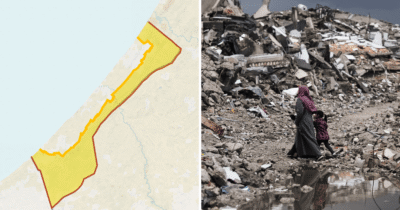
“I don’t know about the Riviera for a while,” Trump said. “It’s blasted. This is like a demolition site.” But he said he hoped to one day visit the territory. “I’d like to put my feet on it, at least,” he said.
A tenuous point in the agreement
The first phase of the ceasefire agreement calls for the release of the final 48 hostages held by Hamas, including about 20 believed to be alive; the release of hundreds of Palestinian prisoners held by Israel; a surge of humanitarian aid to Gaza; and a partial pullback by Israeli forces from Gaza’s main cities.
Israeli troops on Friday finished withdrawing from parts of Gaza, triggering a 72-hour countdown under the deal for Hamas to release the Israeli hostages, potentially while Trump is on the ground there. He said he expected their return to be completed on Monday or Tuesday.
Trump will visit Israel first to meet with hostage families and address the Knesset, or parliament, an honor last extended to President George W. Bush during a visit in 2008. Vice President JD Vance on Sunday said Trump also was likely to meet with newly-freed hostages, too.
“Knock on wood, but we feel very confident the hostages will be released and this president is actually traveling to the Middle East, likely this evening, in order to meet them and greet them in person,” Vance told CBS’ “Face the Nation.”
Trump then stops in Egypt, where he and Egyptian President Abdel-Fattah el-Sissi will lead a summit in Sharm el-Sheikh with leaders from more than 20 countries on peace in Gaza and the broader Middle East.
It is a tenuous truce and it is unclear whether the sides have reached any agreement on Gaza’s postwar governance, the territory’s reconstruction and Israel’s demand that Hamas disarm. Negotiations over those issues could break down, and Israel has hinted it may resume military operations if its demands are not met.
“I think the chances of (Hamas) disarming themselves, you know, are pretty close to zero,” H.R. McMaster, a national security adviser during Trump’s first term, said at an event hosted by the Foundation for the Defense of Democracies on Thursday. He said he thought what probably would happen in the coming months is that the Israeli military “is going to have to destroy them.”
Israel continues to rule over millions of Palestinians without basic rights as settlements expand rapidly across the occupied West Bank. Despite growing international recognition, Palestinian statehood appears exceedingly remote because of Israel’s opposition and actions on the ground,