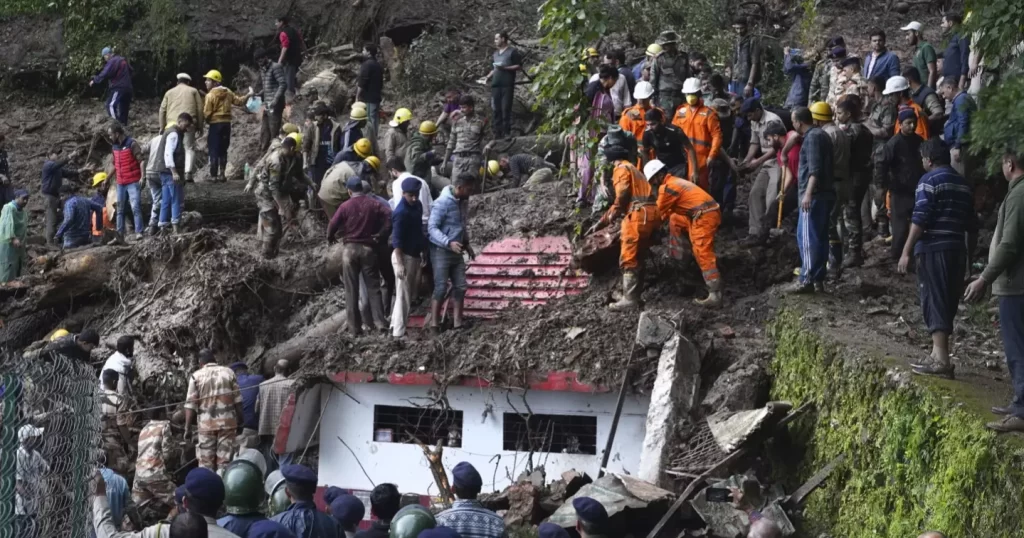
Sanjay Chauhan witnessed monsoon rains lash down over his home and farm in the Indian Himalayas this year with a magnitude and intensity he’s never experienced before.
“Buildings have collapsed, roads are broken, there were so many landslides including one that has destroyed a large part of my orchard,” said the 56-year-old farmer, who lives in the town of Shimla in Himachal Pradesh. “I have not seen anything like this.”
The devastation of this year’s monsoon season in India, which runs from June to September, has been significant: Local government estimates say that 428 people have died and Himachal Pradesh suffered over $1.42 billion worth in property damage since June.
Human-caused climate change is making rain more extreme in the region and scientists warn Himalayan states should expect more unpredictable and heavy seasons like this one. But the damage is also exacerbated by developers paying little mind to environmental regulations and building codes when building on flood- and earthquake-prone land, local experts and environmentalists say.
Damages to property in Himachal Pradesh this year were more than the last five years combined. Other regions also suffered heavy losses in terms of lives, property and farmland — including the neighboring state of Uttarakhand, Delhi and most northern and western Indian states.
The rainfall spurred hundreds of landslides, with overflowing rivers sweeping vehicles away and collapsing multiple buildings, many of them recently constructed hotels. Key highways were submerged or destroyed and all schools in the region were shut. Around 300 tourists stranded near the high altitude lake of Chandratal had to be airlifted to safety by the Indian Air Force.
Jakob Steiner, a climate scientist with the International Center for Integrated Mountain Development, said rising global temperatures from human-caused climate change means more water evaporates in the heat which is then dumped in heavy rainfall events.
And when all the water pours in one place, it means other regions are starved of rain.
In the south of the country, rain was so rare that the region had its driest monsoon season since 1901, the IMD said. The government of Karnataka in southern India declared drought conditions in most of the state.
Climate change compounds the phenomenon of weather extremes, said Anjal Prakash, a research director at the Indian School of Business, with both droughts and deluges expected to intensify as the world warms.
In the Himalayas, the problem of climate changed-boosted rain is worsened by unregulated development and years of devastation piling up with little time to adapt or fix the damage in between.
“Roads, dams and settlements have been built without proper environmental assessments or following building codes,” said Prakash. Unregulated development has also led to increased soil erosion and disrupted natural drainage systems, he said.
Y.P. Sundarial, a geologist with Uttarakhand-based HNB Garhwal University, agrees.
“People here are building six floor buildings on slopes as steep as 45 degrees” in a region that is both flood and earthquake prone, Sundarial said. “We need to make sure development policies keep the sensitiveness of Himalayas in mind to avoid such damage in the future.”
When these structures almost inevitably topple year after year during monsoon rains, it creates a “cumulative impact” said local environmentalist Mansi Asher, meaning residents are now living with years of unaddressed devastation.
Ten years ago, an estimated 6,000 people died in flash floods caused by a cloudburst in Uttarakhand which destroyed hundreds of villages; between 2017 and 2022, around 1,500 people died in Himachal Pradesh from extreme rain-related incidents; and earlier this year at least 240 families were relocated away from the religious town of Joshimath after the ground caved in from over construction despite warnings from scientists.
Governments on the state and national level have been looking at how to address the destruction.
Himachal Pradesh’s government announced a $106 million disaster risk reduction and preparedness program with support from the French Development Agency this year to strengthen its response to extreme rainfall.
The state also published a comprehensive climate action plan in 2022 but many of the plan’s recommendations, such as creating a fund to research climate challenges or helping farmers in the region adapt to changing weather conditions, have not yet been implemented.
The Indian federal government meanwhile has set an ambitious target of producing 500 gigawatts of clean energy by 2030 and has installed 172 gigawatts as of March this year. India is currently one of the world’s largest emitters. The country also created a national adaptation fund for climate change, releasing just over $72 million for various projects since 2015.
But these initiatives are too little, too late for apple farmer Chauhan and others picking up the pieces after an especially catastrophic monsoon season.
Chauhan, who’s also the former mayor of Shimla, wants to see a firm plan that addresses climate change in the face of the region’s growing population and development needs.