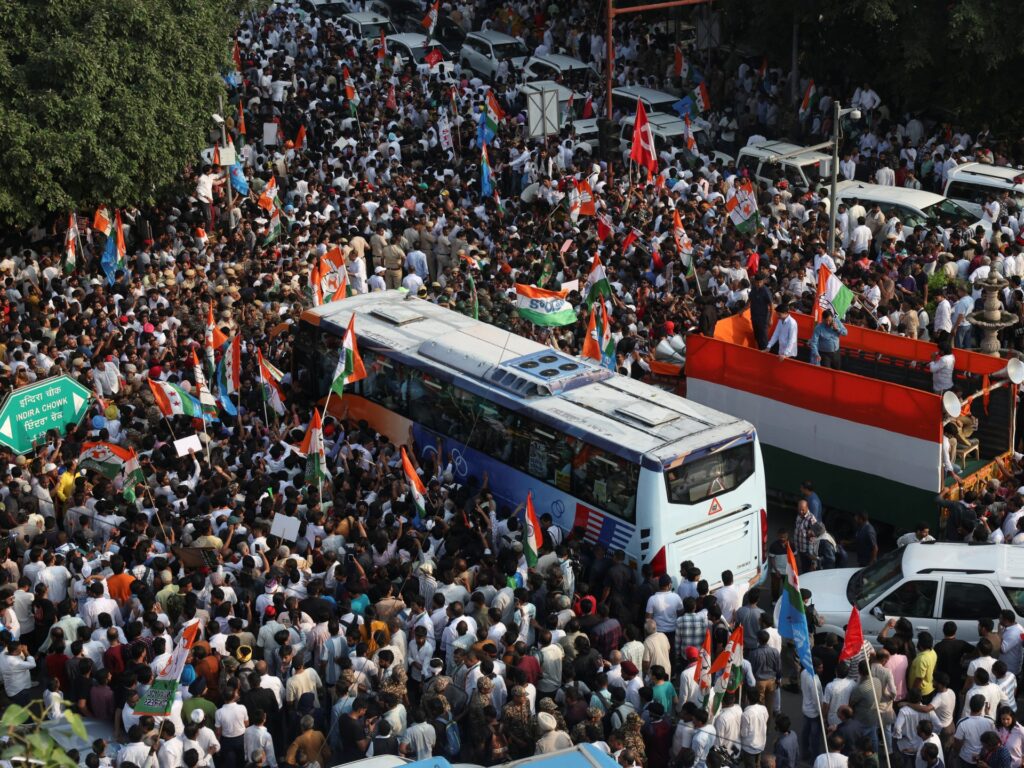
In a significant political development in India, the main opposition party, the Congress, has taken a strong stand against the current Chief Election Commissioner (CEC). The Congress party spearheaded a rally marching towards the Supreme Court, the highest judicial authority in the country, demanding the removal of the CEC. This move underscores the intense political confrontations surrounding the electoral process in India, a critical component of the world’s largest democracy.
The Chief Election Commissioner plays a pivotal role in overseeing free and fair elections across the country, ensuring that the democratic process is upheld without bias. However, recent actions and decisions by the CEC have been met with criticism by the opposition, who allege that the commissioner has compromised the impartiality expected from the office.
The opposition’s march to the Supreme Court is not merely a symbolic gesture but a strategic attempt to seek judicial intervention in what they describe as breaches of democratic principles. By petitioning the Supreme Court, the Congress party aims to challenge the legitimacy and fairness of the current election management and push for reforms or changes in the leadership to restore faith in the electoral system.
This political agitation comes at a crucial time when India is closely preparing for several major elections, including state assembly elections and by-elections across various constituencies. The credibility of the election commission is fundamentally linked to the public’s trust in electoral outcomes, making this confrontation a matter of national importance.
The Supreme Court now faces the delicate task of balancing the constitutional sanctity of the election commission with the concerns raised by the opposition. The court’s decision will have far-reaching implications for India’s electoral integrity and the political landscape.
Political analysts suggest that this confrontation highlights broader issues such as the increasing politicization of constitutional bodies and the challenges in maintaining institutional independence in a fiercely polarized environment. The Congress’s decision to mobilize public support and seek legal recourse signals a deepening political crisis and a call for greater accountability from those managing India’s democratic processes.
The government and the ruling party have responded by defending the actions of the Chief Election Commissioner, asserting that the commission has functioned within the scope of its mandate impartially. They warn that politicizing the election commission could undermine democratic institutions and destabilize the electoral process.
As the story develops, the eyes of the nation and the international community remain fixed on India’s Supreme Court, whose verdict will likely define the course of the upcoming elections and the trust in democratic institutions for years to come. This episode serves as a crucial reminder of the vitality of electoral integrity and the constant vigilance required to protect democratic values in a dynamic political landscape.