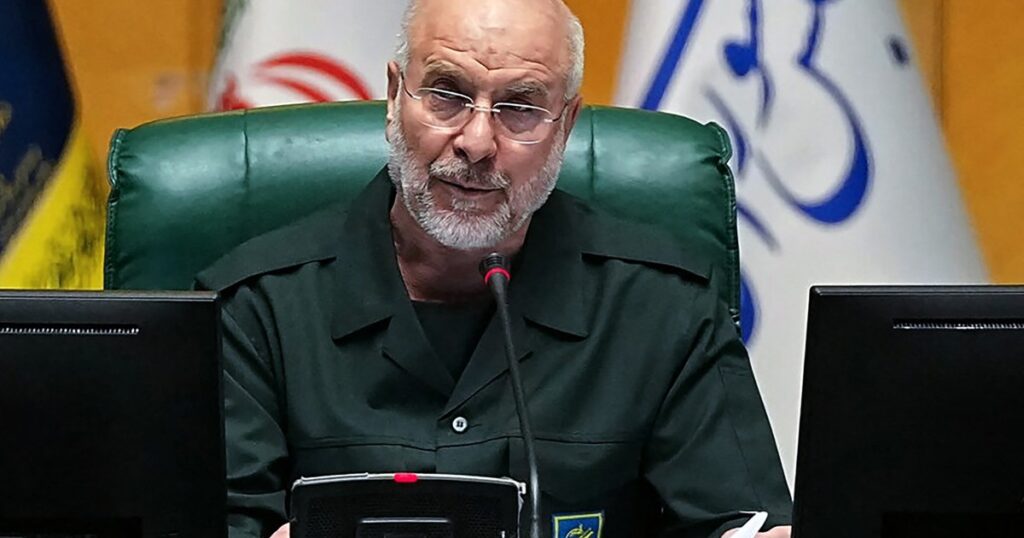
In a striking and somewhat humorous move amid soaring global oil prices and inflation concerns, Iran’s parliamentary speaker, Mohammad Bagher Ghalibaf, has drawn international attention by mocking US interest rate decisions through a complicated economic reference: the Taylor equation. This scholarly jibe raises questions about the geopolitics of rates and inflation.
Ghalibaf’s comments come at a time when the United States Federal Reserve’s handling of interest rates has significant global repercussions. The Taylor equation, or Taylor rule, is a formula developed by economist John B. Taylor to guide central banks on how they should adjust interest rates in response to inflation and economic output changes. Essentially, it provides a benchmark for setting federal funds rates based on inflation gaps and output gaps.
By invoking the Taylor rule, Ghalibaf slyly critiqued the US monetary policy suggesting that the Federal Reserve’s current interest rate decisions may not align with this academic standard. He implied that the US might be artificially manipulating rates for geopolitical advantages, possibly impacting global markets and specifically benefiting at the expense of nations like Iran.
This mockery highlights Iran’s rising political confidence amid economic pressures sustained by sanctions and fluctuating oil markets. As oil prices climb, inflation follows suit globally, and central banks including the Fed face tough choices balancing growth and inflation control. Ghalibaf’s rhetorical question — “Is Iran fixing US interest rates?” — plays on irony, insinuating that US domestic monetary decisions are under an indirect influence, possibly by Iran or linked to geopolitical factors beyond straightforward economic reasoning.
Experts analyzing the situation note that while it’s not plausible that Iran literally fixes US interest rates, such statements expose the perception of global economic interdependence and the intertwining of finance with geopolitics. The Federal Reserve’s moves naturally impact commodities like oil, and in turn, oil-producing countries including Iran face both rewards and repercussions.
Iran’s speaker’s message also underlines the broader discourse on the transparency and fairness of international economic policies. Criticism of the US monetary approach via a technical economic formula adds a nuanced layer to political rhetoric and suggests that economic policy is as much a tool of politics as it is of financial regulation.
Amid rising inflation rates in many countries and unpredictable oil market dynamics, Ghalibaf’s statement effectively symbolizes the tension between national economic sovereignty and global economic forces. It reflects Iran’s stance that global economic policies, including US interest rates, might be more complex and interconnected than they appear on the surface.
In conclusion, while Iran’s speaker’s comments are partly satirical and politically charged, they invite a deeper reflection on the global impact of US monetary policy and how economic decisions resonate far beyond national borders. The subtle reference to the Taylor rule serves not just as a critique but as a reminder of the sophisticated interplay between economics and geopolitics in an increasingly interconnected world economy.