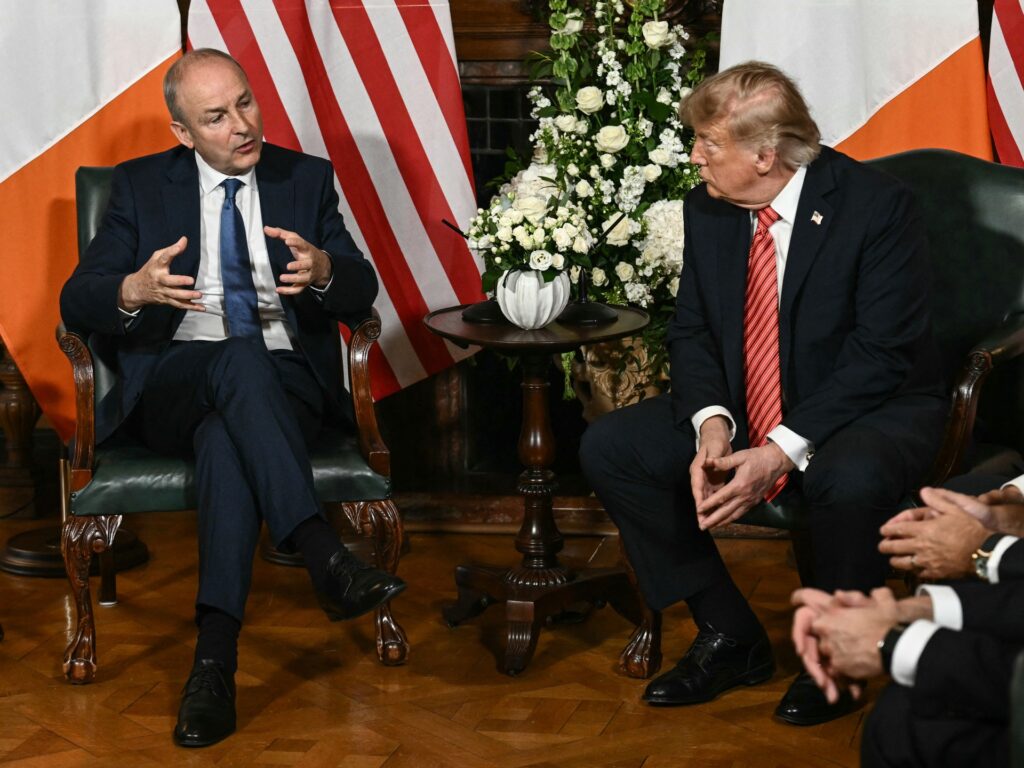
During a recent visit to Ireland, former U.S. President Donald Trump expressed his positive view on the idea of a unified Ireland, stating that it would be ‘fantastic.’ His remarks come amidst ongoing discussions and debates regarding the future political status of Northern Ireland.
Trump’s comments highlight his optimistic stance toward the prospect of Northern Ireland uniting with the Republic of Ireland. The notion of a unified Ireland has been a significant topic in British and Irish political circles, especially following Brexit and the complexities it introduced concerning the border between Northern Ireland and the Republic of Ireland.
In contrast to Trump’s supportive remarks, British Prime Minister Andy Burnham has taken a more cautious position. Burnham asserts that there is currently not enough popular support within Northern Ireland for it to leave the United Kingdom. His statement underscores the delicate political environment and the diverse opinions among Northern Ireland residents regarding their future.
Northern Ireland has long been a region marked by political and sectarian divisions. The question of reunification with the Republic of Ireland touches on historical conflicts, identity, and governance. Recent years have seen increased attention to this issue due to Brexit and its impact on the Irish border and trade.
Trump’s visit to Ireland, which included meetings with various political and community leaders, was seen by many as an opportunity to discuss broader Irish-American relations and key issues concerning the island. His endorsement of a united Ireland was received with mixed reactions, highlighting the complexity of the issue across both Ireland and the United Kingdom.
The British government’s position, as articulated by Prime Minister Burnham, reflects the current reluctance to alter the constitutional status of Northern Ireland without clear popular consent. The Good Friday Agreement, which helped establish peace in the region, also stipulates that any change in Northern Ireland’s status should only happen with majority support.
Political analysts suggest that the debate around Northern Ireland’s future will continue to evolve as demographic changes occur and as economic and political pressures develop. The conversations sparked by statements like Trump’s and Burnham’s highlight the ongoing nature of this critical issue.
This divergence in viewpoints emphasizes the importance of dialogue and careful consideration in addressing Northern Ireland’s future. It also reflects the broader challenges faced by governments in managing peace and unity in areas with complex histories and identities.
As the situation develops, stakeholders from all sides are likely to continue engaging in discussions that balance historical context, current realities, and future aspirations. The contrasting perspectives offered by figures like Trump and Burnham provide insight into the multifaceted nature of the debate over Northern Ireland’s political future.