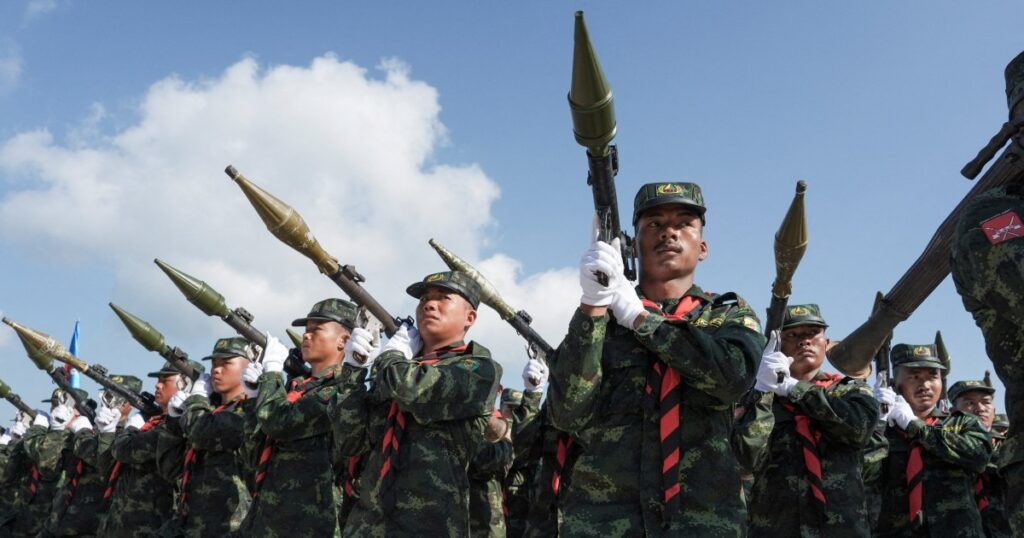
The recent developments in Myanmar reflect a significant shift in the ongoing conflict between the military and rebel forces. After a period marked by fierce resistance from various ethnic armed groups and militias, the Myanmar military, often referred to as the Tatmadaw, has started to regain control over several key territories.
This revival of military strength is attributed to multiple factors, chief among them being relentless air raids that have significantly weakened opposition strongholds. The military’s aerial campaign has been intense and continuous, allowing government forces to reclaim strategic towns that had been under rebel control for months.
Another crucial element in the Tatmadaw’s resurgence is the increased conscription of young men. Fresh recruits have bolstered the ranks of the military, providing the manpower needed to sustain offensives and hold reclaimed areas. This influx of conscripts demonstrates the military’s commitment to a long-term campaign to reassert dominance over contested regions.
Furthermore, China’s support has played a pivotal role in Myanmar’s military operations. While direct intervention is subtle, China’s strategic backing has enhanced the Tatmadaw’s capabilities through supplies, training, and possibly intelligence assistance. This partnership underscores China’s interest in maintaining stability in the region and protecting its economic interests linked to Myanmar.
The confluence of relentless air power, fresh troops, and external support has shifted the momentum in favor of the military. Rebel fighters, once holding vital towns and territories, have been forced into retreat, losing ground rapidly. The loss of these key towns not only undermines the rebels’ ability to operate but also affects the morale of opposition forces.
This resurgence carries significant implications for Myanmar’s future. The military’s regained control could mean a prolonged conflict as opposition groups are pushed to adapt their strategies or negotiate under unfavorable conditions. Civilians in conflict zones face displacement and hardship due to intensified military actions.
International observers remain concerned about the humanitarian impact and call for renewed efforts to mediate peace talks. The evolving dynamics underscore the complexity of Myanmar’s conflict, where military strength, regional alliances, and local resistance intertwine to shape the country’s turbulent trajectory.
In summary, the Myanmar military’s recent advances demonstrate a multifaceted approach to reclaiming power. Through sustained air raids, an expanded conscript army, and crucial Chinese support, the Tatmadaw is reshaping the battlefield and altering the conflict’s direction. As the situation continues to unfold, the balance of power remains delicate, with significant consequences for all parties involved.