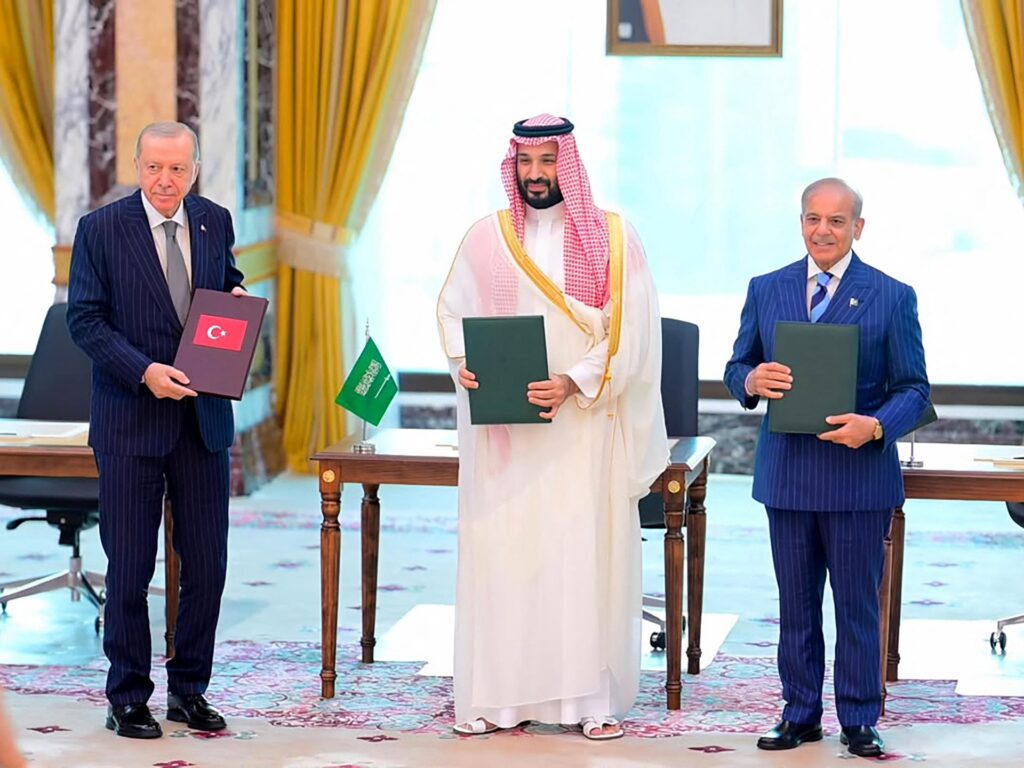
In the evolving geopolitical landscape of the Middle East and South Asia, the recent Saudi-Pakistan-Turkiye pact has attracted considerable attention. This alliance between Saudi Arabia, Pakistan, and Turkey represents a significant strategic alignment, particularly in the context of diminishing American influence in the region. Analysts have weighed in on Iran’s stance towards this pact, noting that Iran does not appear to feel immediately threatened by this new coalition.
Iran’s official response has been measured, with key government figures and analysts emphasizing a focus on the broader shift in regional power dynamics rather than expressing overt opposition to the pact. The prevailing view among Iranian observers is that the agreement highlights the reduced role of the United States in regional affairs, a development Tehran has long anticipated and often welcomed.
The pact between Saudi Arabia, Pakistan, and Turkey is seen by Iran as a potential platform that might contribute to reshaping alliances and partnerships beyond the traditional US-centric framework. While these countries have contrasting interests and historical tensions, their coming together suggests a pragmatic approach to counterbalance American disengagement.
Iran maintains a complex relationship with each member of the pact. With Saudi Arabia, Iran has a history marked by rivalry and sectarian tensions, yet recent years have seen tentative overtures toward dialogue. Pakistan, on the other hand, has strong economic and military ties with Iran, alongside its longstanding relationship with Saudi Arabia, placing Islamabad in a delicate balancing act. Turkey shares ideological and economic connections with Iran but has also aligned itself with Saudi Arabia on various fronts.
The analysts highlight that Iran’s cautious posture stems from an understanding that this pact does not immediately alter the power dynamics in a way that threatens its national interests directly. Instead, Iran appears to be adopting a wait-and-see approach, monitoring how the pact evolves and the implications it may have for the regional balance.
Moreover, Iran’s strategic calculus includes leveraging these shifts to its advantage. The diminishing American footprint in the Middle East offers Tehran opportunities to strengthen its influence, expand economic partnerships, and assert a more autonomous regional role. The Saudi-Pakistan-Turkiye alliance may, paradoxically, create openings for Iran to engage with these countries under new terms and in a context less dominated by US geopolitical strategies.
Experts contend that any future interactions between Iran and this tripartite alliance will likely be characterized by pragmatic diplomacy, selective cooperation, and cautious competition. Iran’s immediate focus remains on stabilizing its regional position amidst ongoing challenges and on advancing its long-term vision for regional integration without overt confrontation.
In summary, Iran’s stance on the Saudi-Pakistan-Turkiye pact is defined by a nuanced assessment that recognizes the alliance’s significance but does not perceive it as an immediate threat. Instead, Iranian officials and analysts are concentrating on the broader theme of diminishing US influence in the region and exploring how this shift might realign power relations. This perspective underscores Iran’s strategic patience and its intent to navigate the changing geopolitical currents with a focus on safeguarding and advancing its national interests.