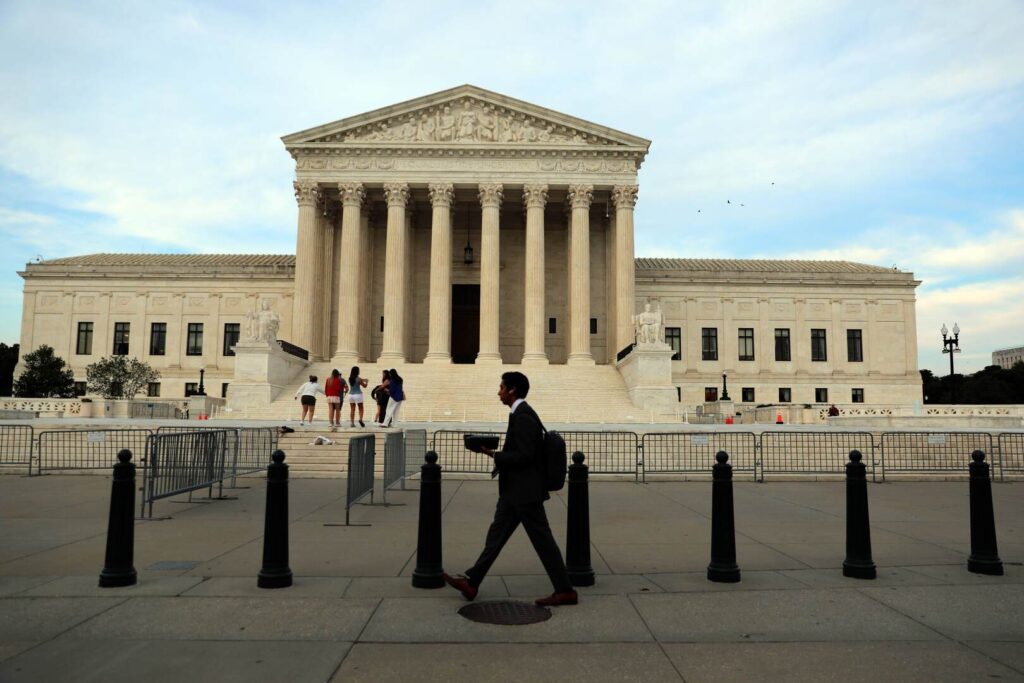
The U.S. Supreme Court is photographed on Thursday, June 25, 2026, in Washington. (AP Photo/Rahmat Gul)
The independence of the U.S. Supreme Court, long considered a cornerstone of American democracy, is facing unprecedented challenges in today’s politically charged climate. Legal scholar Kim Wehle highlights that increasing threats against judges are eroding the rule of law and raising urgent questions about the Court’s ability to remain impartial and insulated from external pressures.
Judicial independence is critical because it ensures that judges can make decisions based solely on the law and constitutional principles without fear of retaliation or influence from political entities or public opinion. However, recent years have seen a rise in attacks—both verbal and in physical threats—aimed at Supreme Court justices, often fueled by highly contentious cases that evoke strong emotions across the political spectrum.
The environment surrounding the Court has become increasingly polarized. Key decisions on topics such as abortion rights, gun control, and voting laws have intensified public scrutiny and hostility. This adversarial atmosphere threatens to undermine public trust in the judiciary’s objectivity and fairness.
Kim Wehle argues that the escalating hostility not only jeopardizes the safety and well-being of individual justices but also threatens the foundational principle that the judiciary must act independently to uphold the Constitution. When judges face intimidation, there is a risk that decisions will be swayed by external pressures rather than legal merits.
Moreover, the political nature of judicial appointments exacerbates this problem. Justices are appointed by the President and confirmed by the Senate, often after a highly partisan process. This can create a perception that justices are political actors rather than impartial arbiters, further eroding public confidence.
To safeguard judicial independence, experts suggest several measures, including enhancing security for justices and their families and promoting civility in public discourse surrounding judicial decisions. Additionally, there is a growing call for reforms to reduce the politicization of judicial appointments, such as instituting term limits for Supreme Court justices or modifying the confirmation process.
Educational efforts to increase public understanding of the judiciary’s role and the importance of its independence are also vital. When citizens appreciate that courts must interpret laws impartially without influence from popular sentiment or political pressure, it can build resilience against efforts to undermine the judiciary.
The challenge is significant: maintaining the U.S. Supreme Court’s independence in an era marked by deep political divides and intense scrutiny requires concerted efforts from all branches of government, the legal community, and the public. The Court’s ability to function as an impartial guardian of the Constitution depends on protecting judges from threats and preserving the principle that justice must be free from fear, favor, or partisan influence.
Ultimately, the health of American democracy hinges on a Supreme Court that can stay independent despite rising threats. The nation must confront these challenges directly to ensure that the rule of law remains strong and that the judicial branch can fulfill its crucial role without compromise.