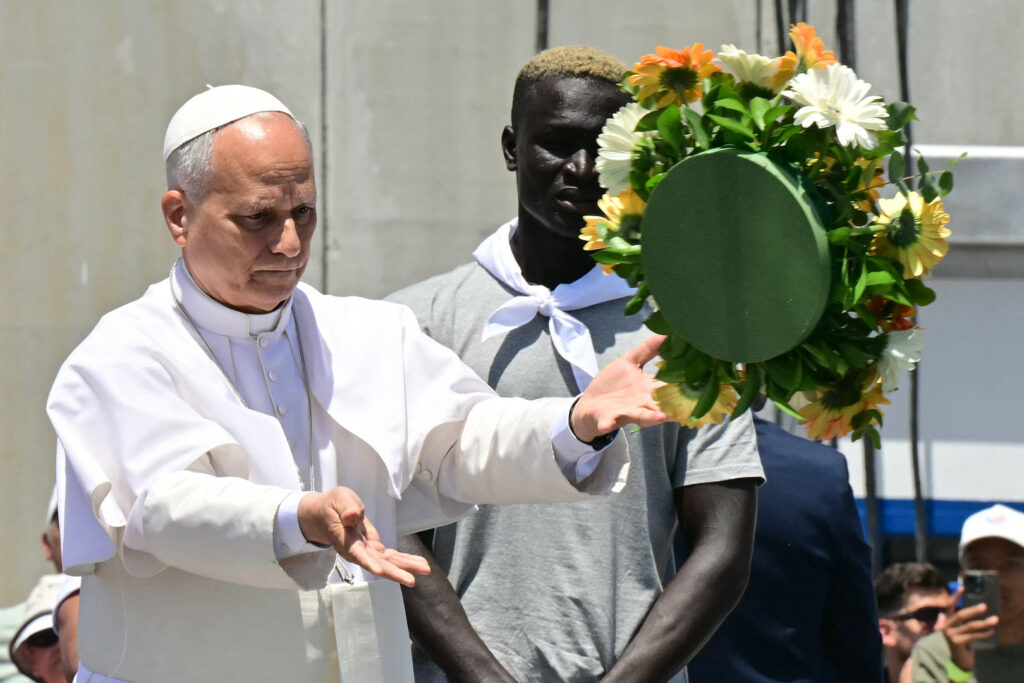
Pope Leo XIV, flanked by two migrants, throws a wreath to the sea to remember all the migrants who perished during their journey, at the Port of Arguineguin on the Canary Island of Gran Canaria, a place accustomed to the arrival of migrants, on June 11, 2026. Pope Leo XIV is visiting Spain June 6-12 with stops in Madrid, Barcelona, and the Canary Islands, where he will meet with migrants and organisations dedicated to helping them. (Photo by Stefano RELLANDINI / AFP)
Pope Leo recently made a poignant visit to the Portuguese port in Spain’s Canary Islands, a location infamous as the ‘dock of shame’ due to the dire conditions faced by migrants arriving there. During his visit, Pope Leo met with both migrants arriving at the port and representatives of NGOs working tirelessly to support them in the challenging environment.
Highlighting the human dignity of those seeking refuge and new beginnings, Pope Leo publicly declared, ‘I bow before your dignity.’ These powerful words underscore the pope’s commitment to recognizing and validating the humanity and resilience of people who often endure harrowing experiences on their journeys.
The Canary Islands have become one of the key entry points into Europe for migrants fleeing conflict, poverty, and persecution. Many arrive after dangerous sea voyages in overcrowded and unsafe vessels, facing extreme hardship before even reaching land.
NGOs and humanitarian organizations have long criticized the conditions at the port, drawing attention to inadequate facilities and the urgent need for better support systems. The term ‘dock of shame’ reflects the shame felt by many over the lack of sufficient response and resources dedicated to these vulnerable populations.
In visiting the port, Pope Leo sought not only to offer spiritual encouragement but also to draw global attention to the ongoing migration crisis. His engagement with migrants and aid workers serves as a call for compassion, solidarity, and action.
The pope’s words and presence at the Canary Islands echo broader themes within his papacy, emphasizing the importance of welcoming strangers and upholding human rights. His advocacy highlights the necessity of addressing root causes of migration while fostering welcoming communities.
This visit is part of a larger effort by religious leaders and humanitarian groups to influence policies and encourage more humane treatment of migrants worldwide. Pope Leo’s message stresses the universal respect owed to every individual, regardless of their nationality or circumstances.
As the world grapples with mass displacement and increasing migrant flows, the pope’s statement offers a reminder of shared human dignity amidst complex challenges. His acknowledgment resonates deeply with migrants who often experience marginalization and exclusion.
The meeting also provided a platform for migrants to share their stories, bringing personal insight to the broader migration debate. These testimonies underscore the urgency of creating sustainable solutions that protect human rights and dignity.
In conclusion, Pope Leo’s visit to the so-called ‘dock of shame’ in the Canary Islands is a significant gesture that not only honors the bravery and dignity of migrants but also calls upon the international community to respond with empathy and justice. His words reaffirm the fundamental principle that every human life deserves respect and care, no matter the struggles endured.