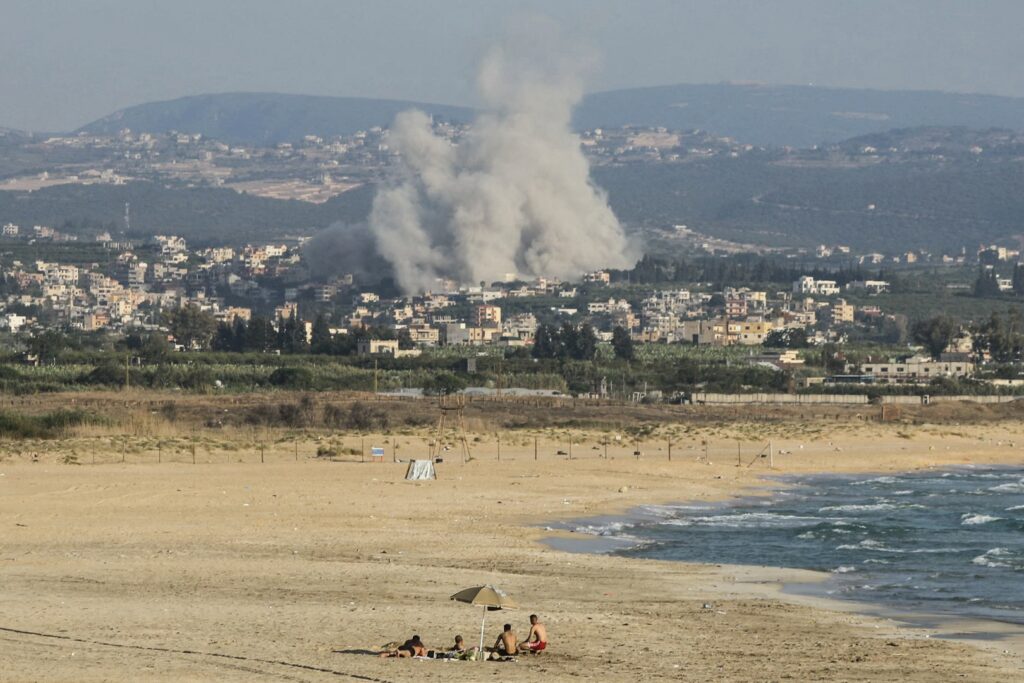
A photograph taken from the southern city of Tyre shows people sunbathing on the beach as smoke rises from the site of an Israeli airstrike in the village of Deir Qanoun Ras al-Ain on June 8, 2026. The Israeli defence minister vowed on June 8 to press on with Israel's military campaign in Lebanon, despite a warning from Iran that any such action would prompt the Islamic republic to take "severe" measures in response. (Photo by Kawnat HAJU / AFP) /
The geopolitical landscape in the Middle East remains tense as Israel announces a shift in its military focus. Israeli Prime Minister Benjamin Netanyahu has confirmed a halt in strikes against Iran, signaling a temporary diplomatic or strategic pause in that front. However, despite this cessation of hostilities with Iran, Israel continues to conduct military operations targeting Hezbollah in Lebanon.
This decision by Netanyahu underscores the complex security concerns facing Israel, particularly the perceived ongoing threat from Hezbollah, the Lebanon-based militant group and political party. Israeli officials have frequently cited Hezbollah’s extensive arsenal and its close ties with Iran as justification for sustained military vigilance.
The Israeli government’s military strategy appears to be carefully calibrated to address different threat levels and regional dynamics separately. While the temporary halt on Iranian strikes may indicate diplomatic openings or a reassessment of priorities, the persistent activity against Hezbollah suggests that Israel views the group as an immediate and direct security risk.
Hezbollah, which has been involved in numerous conflicts with Israel over the years, continues to pose challenges due to its significant military capabilities and entrenched presence in southern Lebanon. Israeli strikes often aim to disrupt arms transfers and infrastructure linked to the group, aiming to weaken Hezbollah’s operational capacity.
Netanyahu’s announcement came amidst ongoing regional tensions and a complex web of alliances and enmities. Iran’s influence in Lebanon and support for Hezbollah remain critical issues in the regional power balance. While Israel’s actions against Iran have temporarily ceased, the broader confrontation between the two countries remains unresolved.
Analysts suggest that Israel’s decision to halt attacks on Iran might be influenced by international diplomatic pressures, potential back-channel communications, or strategic recalibrations in light of current global and regional conditions. Conversely, the continuation of strikes in Lebanon reflects a localized focus on immediate threats rather than a broader strategic withdrawal.
This dual approach indicates Israel’s nuanced security calculus, wherein Tehran is viewed as a longer-term strategic adversary, while Hezbollah represents an active battlefield threat necessitating ongoing military attention.
The situation remains fluid, with potential implications for regional stability and international diplomacy. Observers will be closely monitoring Israel’s next moves, Hezbollah’s response, and Iran’s broader strategic intentions in the Middle East.
In summary, Israel’s announcement highlights a significant adjustment in its military engagements: suspending conflict with Iran while maintaining an aggressive posture against Hezbollah in Lebanon. This decision encapsulates the intricate and multi-faceted nature of Middle Eastern geopolitics, where different threats and relationships are managed through distinct and sometimes simultaneous approaches.