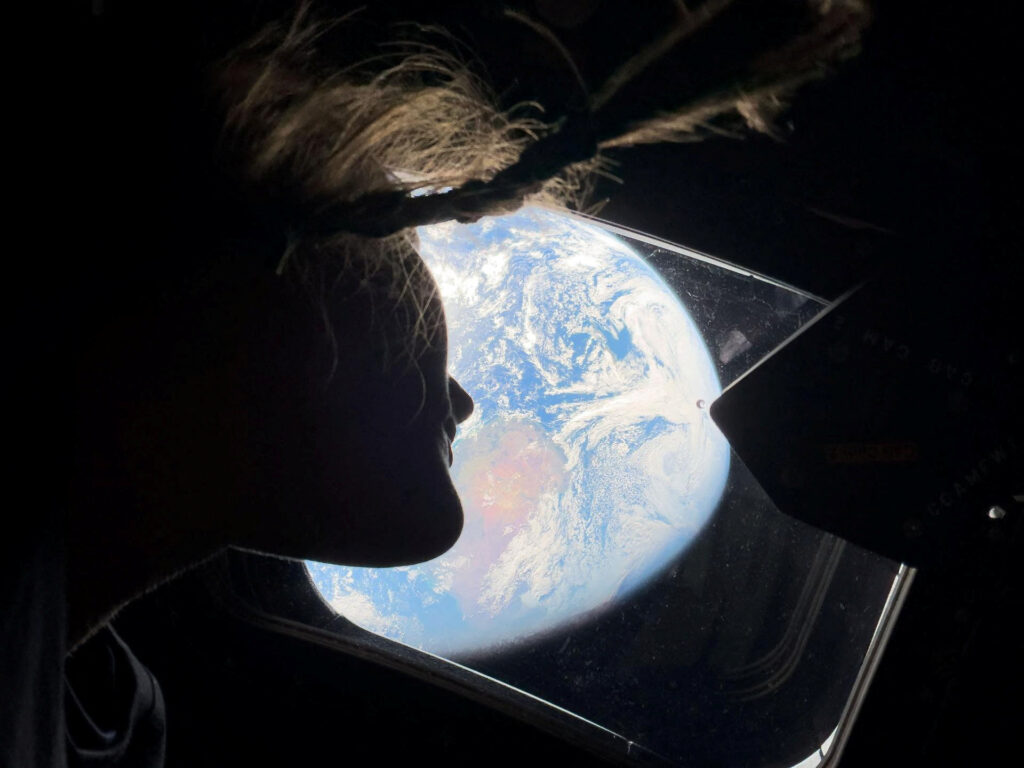
NASA astronaut and Artemis II mission specialist Christina Koch peers out of one of the Orion spacecraft's main cabin windows, looking back at Earth, as the crew travels towards the Moon April 2, 2024. NASA/Handout via REUTERS. THIS IMAGE HAS BEEN SUPPLIED BY A THIRD PARTY
In a historic achievement for space exploration, NASA’s Artemis II mission has broken the record for the farthest human travel from Earth. The mission’s four astronauts have surpassed the distance previously set by Apollo 13 in 1970, which reached 400,171 kilometers from our planet.
Artemis II represents a monumental step forward as humanity continues to push the boundaries of space travel. The mission’s success demonstrates the ongoing commitment to advancing human presence beyond low Earth orbit and paves the way for future deep space exploration.
The crew embarked on their journey with goals that include testing new technologies and systems designed for longer, more challenging missions, such as those planned for Mars and beyond. Breaking this distance record not only marks a symbolic victory but also provides valuable data on space travel’s effects on the human body and equipment durability far from Earth’s protective environment.
NASA officials and the broader space community have hailed this achievement as a significant milestone. The Artemis program is designed to eventually establish a sustainable human presence on the Moon, serving as a springboard for missions into deeper parts of space.
The comparison to Apollo 13 is particularly noteworthy given the challenges faced during that mission, which was an unintended near-disaster but turned into a successful, safe return for its crew. Now, over 50 years later, Artemis II has taken humanity farther and with the intention of setting the stage for more ambitious exploration.
International interest in Artemis II remains high, with multiple space agencies and private entities watching closely. The data gathered from this mission will inform future projects and collaborations, enhancing our capabilities in human spaceflight.
Moreover, the successful execution of Artemis II aligns with broader scientific, economic, and geopolitical interests in space, highlighting the importance of sustained investment in space programs.
The achievements of Artemis II inspire a new generation, reminding us of human curiosity and our enduring desire to explore the unknown. As the mission continues to unfold, it promises to deliver critical insights and pave the way for the next era of human space exploration.