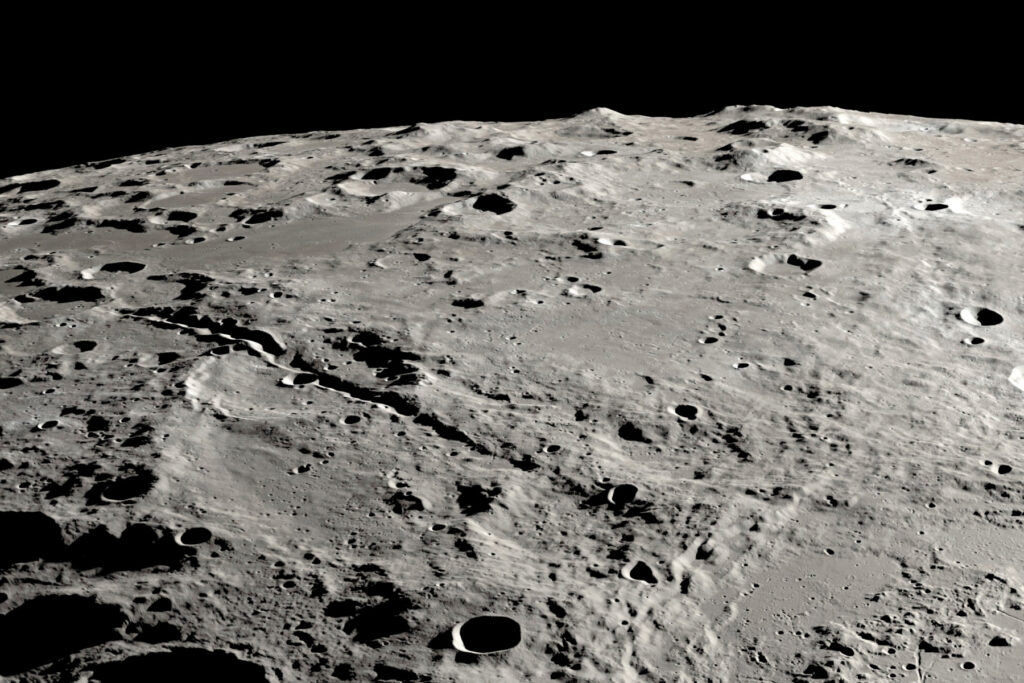
ARCHIVO - Esta foto sin fecha, proporcionada por la NASA, muestra una vista desde la órbita de la superficie lunar. (Ernie T. Wright/NASA vía AP, archivo)
NASA has announced a significant investment plan amounting to $20 billion aimed at advancing human space exploration. The budget will primarily focus on establishing a permanent base on the Moon and developing a nuclear-powered spacecraft designed for missions to Mars.
The Moon base initiative is set to increase robotic missions, which will pave the way to building a sustainable human presence on the lunar surface. These robotic missions will help in setting up infrastructure, conducting scientific research, and preparing for human colonization.
Alongside the Moon base plans, NASA will launch a revolutionary nuclear spacecraft called Space Reactor 1 Freedom. This nuclear-powered spacecraft represents a cutting-edge technology that promises to transform how humans travel in deep space. The nuclear reactor onboard Space Reactor 1 Freedom will provide sustained energy, increased propulsion capabilities, and enhanced mission duration, enabling longer and more ambitious explorations.
The shift towards nuclear propulsion is seen as a critical step in overcoming the limitations of traditional chemical rockets, which are constrained by fuel capacity and efficiency. Space Reactor 1 Freedom is expected to drastically reduce travel time between Earth and Mars, making human missions to the Red Planet more feasible.
NASA’s $20 billion investment reflects a growing commitment to establish the Moon as a strategic foothold for space exploration. This base will serve not only as a scientific outpost but also as a testbed for technologies and skills needed for future deep space missions.
The Moon base project will include development of habitats, life support systems, power generation, and communication infrastructure. It will also play a role in resource utilization, such as extracting water ice for fuel and life support, which is vital for long-duration missions.
Robotic missions preceding human arrival will deploy automated systems to build and maintain the base, conduct geological surveys, and develop methods to extract and utilize lunar resources.
The nuclear-powered Space Reactor 1 Freedom will undergo extensive testing to ensure safety, reliability, and performance before its maiden mission. It uses advanced nuclear technology optimized for space travel, which produces continuous power unlike solar panels that depend on sunlight.
By combining a lunar base with advanced nuclear propulsion technology, NASA aims to create a sustainable exploration infrastructure. This dual approach accelerates the timeline for sending astronauts to Mars and supports long-term human presence beyond Earth.
The $20 billion plan also includes funding for scientific research, technology development, and collaboration with international space agencies and private industry partners.
This new chapter in space exploration highlights NASA’s vision to extend humanity’s reach deeper into the solar system, fostering innovation, international cooperation, and inspiring the next generation of scientists and explorers.
Overall, NASA’s investment in a Moon base and the Space Reactor 1 Freedom nuclear spacecraft marks a transformative step toward sustainable interplanetary missions and the future colonization of Mars.