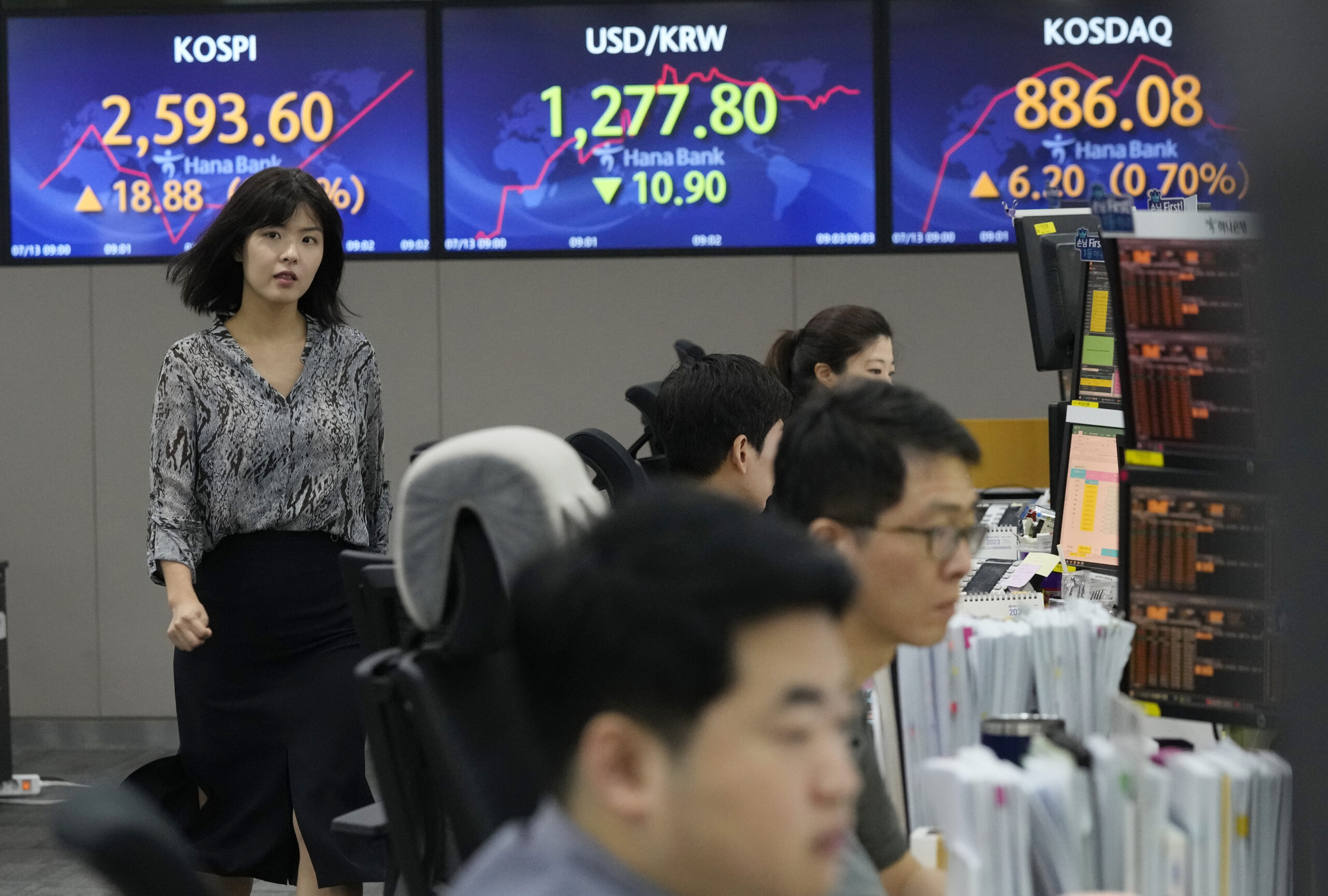
A currency trader passes by screens showing the Korea Composite Stock Price Index (KOSPI), top left, and the foreign exchange rate between U.S. dollar and South Korean won, top center, at the foreign exchange dealing room of the KEB Hana Bank headquarters in Seoul, South Korea, Thursday, July 13, 2023. Asian shares rose Thursday, boosted by Wall Street's return to its highest level in more than a year after a report showed U.S. consumer inflation cooled a bit more than expected last month. (AP Photo/Ahn Young-joon)
hare prices were mixed on Monday after the Israeli government declared war following deadly attacks by Hamas from the Gaza Strip.
U.S. futures were lower and oil prices gained more than $3 a barrel.
Conflict in the Middle East often raises the specter of higher oil prices given the risk of disruptions to supplies.
The fighting has not yet had any discernible impact on oil output, but geopolitical escalations in the Middle East typically lead to a “buy-first-ask-questions-later” response, he said.
Brent crude, the pricing basis for international trading, advanced $3.11 per barrel to $87.69 per barrel.
Tokyo and several other Asian markets were closed for holidays on Monday. Shanghai reopened after a weeklong holiday, falling about 0.7% to 3,088.94. In Australia, the S&P/ASX 200 was up 0.3% at 6,974.60. India’s Sensex slipped 0.4% to 65,744.95.
Bangkok’s SET was down 0.7%.
Hong Kong’s market was closed in the morning due to typhoon warnings but was due to reopen in the afternoon.
The two-day toll from the fighting in the Middle East surpassed 1,100 dead and thousands wounded on both sides. Palestinian militant groups claimed to be holding more than 130 captives from the Israeli side. Israel’s declaration of war raises the question if it would launch a ground assault into Gaza, which in past situations has resulted in heavy casualties.
U.S. Defense Secretary Lloyd Austin ordered the Ford carrier strike group to sail to the Eastern Mediterranean to be ready to assist Israel, in a move meant to help deter any regional expansion of the conflict.
On Friday, Wall Street rallied after investors studied the nuances of a surprisingly strong report on U.S. employment that initially caused stocks to tumble on fears that upward pressure on inflation will lead the Federal Reserve to keep interest rates high.
The S&P 500 rose 1.2% to 4,308.50, the Dow jumped 0.9% to 33,407.58 and the Nasdaq composite flipped to a gain of 1.6%, closing at 13,431.34.
Treasury yields leaped following the release of the report, and the yield on the 10-year Treasury again soared to its highest level since 2007. It was at 4.80% early Monday, up from 4.72% late Thursday.
Wall Street hates high interest rates because they knock down prices for all kinds of investments. And even though the job market hasn’t faltered yet despite the Fed pulling its main interest rate to the highest level since 2001, high rates work to extinguish high inflation by slowing the entire economy. That raises the risk of a recession down the road.
Among the potentially encouraging signals for the Fed: Workers’ average wages rose at a slower rate in September than economists expected. While that’s discouraging for workers trying to keep up with inflation, it could remove some inclination by companies to keep raising prices for their products.
Reports this week on inflation at both the consumer and wholesale levels are the next big data points due before the Fed makes its next announcement on interest rates on Nov. 1.