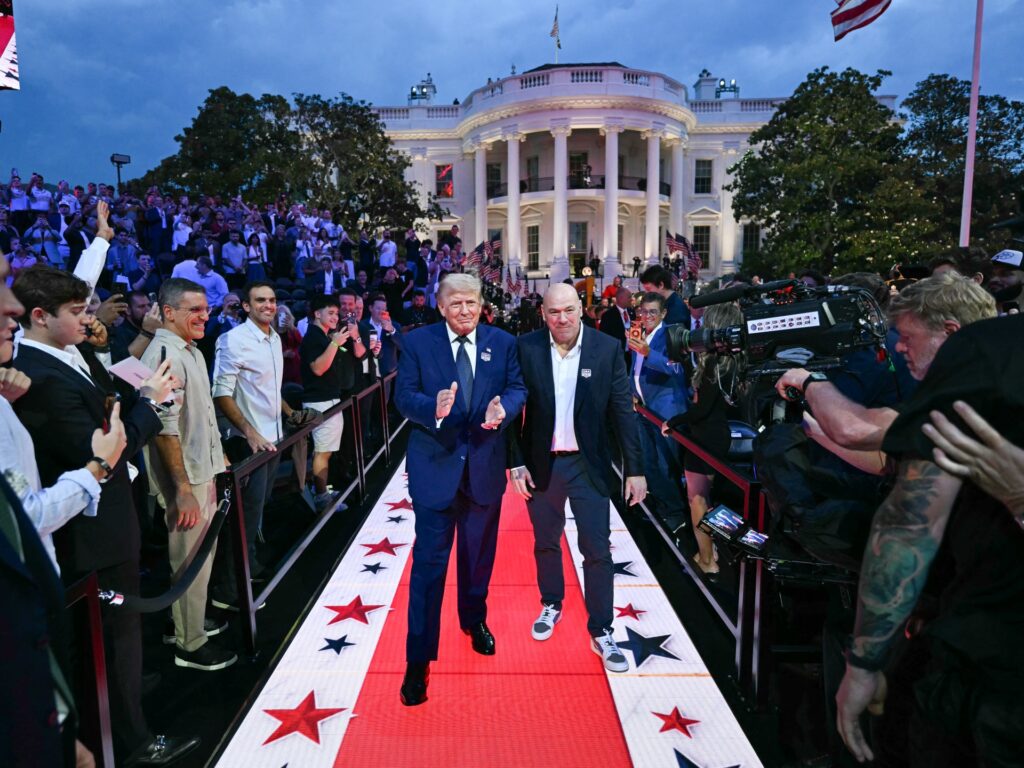
In a surprising political development, former President Donald Trump has expressed interest in appointing UFC chief Dana White as his new White House press secretary. This potential appointment reflects more than just a change in personnel; it underscores a strategic move by Trump to connect with a broader and younger demographic.
Trump and Dana White share a longstanding business relationship that spans decades. Their partnership dates back to the early days of the UFC, when Trump played a pivotal role in promoting mixed martial arts as a mainstream sport. Over the years, their collaboration has extended beyond business, with White often acting as a bridge to a passionate community of sports fans.
White’s dynamic personality and unfiltered communication style align well with Trump’s own approach to public messaging. Known for his straightforward, candid, and sometimes controversial remarks, White has the ability to energize audiences and generate media attention, qualities that are essential for an effective press secretary.
Moreover, White has been instrumental in helping Trump reach out to younger voters, a demographic that the former president has struggled to consistently engage. Mixed martial arts, as a sport, enjoys immense popularity among millennials and Gen Z, and White’s influence within this community could provide Trump with a valuable platform to refresh his image and broaden his appeal.
Political analysts see this potential appointment as a signal that Trump is seeking to modernize his communication strategy ahead of future campaigns or public appearances. By leveraging Dana White’s popularity and unorthodox style, Trump aims to capture the attention of media outlets and social media platforms frequented by younger audiences.
However, critics argue that appointing a figure from the sports entertainment world, especially one as divisive as White, could further polarize the political discourse. The role of the White House press secretary is traditionally one of diplomacy and nuance, attributes that may clash with White’s brash persona.
Despite these concerns, Trump’s interest in Dana White signals an ongoing trend where politics and entertainment increasingly intersect. This blending of domains is reshaping how political messages are crafted and delivered, emphasizing personality and spectacle alongside policy.
In essence, the potential collaboration between Trump and White exemplifies a strategic effort to harness the power of popular culture to influence the political landscape. As the political arena continues to evolve, unconventional alliances like this could become a defining feature of future campaigns and governance.