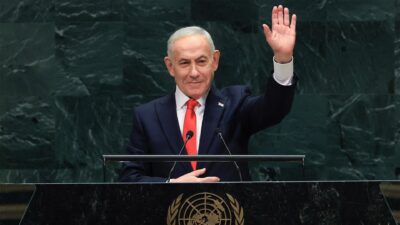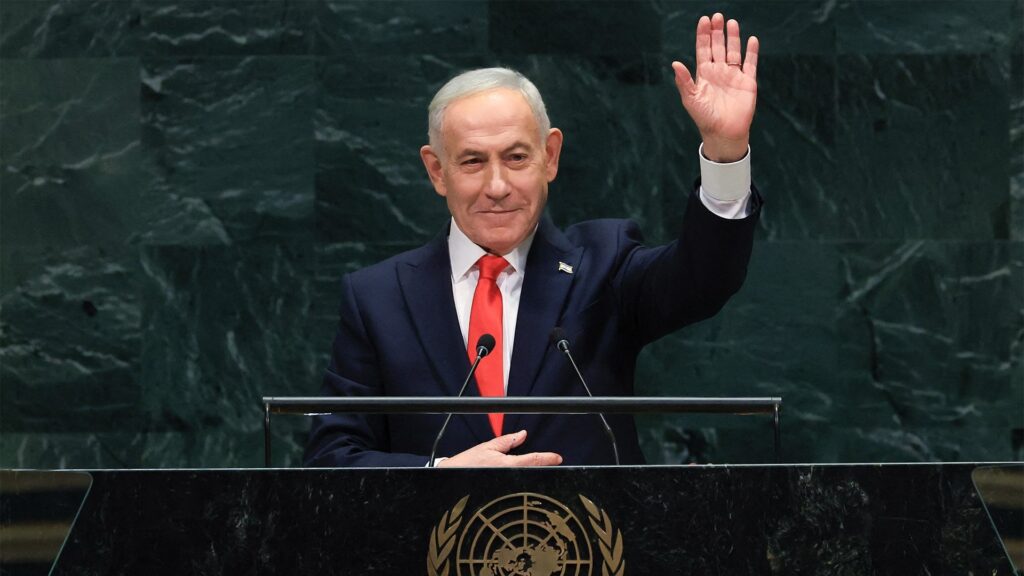
Israeli Prime Minister Benjamin Netanyahu recently addressed the situation in the occupied West Bank at the United Nations, where he notably downplayed the extent of settler violence in the region. Netanyahu attributed the violent incidents to what he described as ‘juvenile delinquents,’ suggesting that the perpetrators of the violence are merely a small, unruly minority rather than a widespread issue. This characterization came amid heightened tensions and clashes in the area, where violence linked to Israeli settlers and Palestinian residents has been escalating.
The West Bank, a territory under Israeli occupation since 1967, has long been a focal point of the Israeli-Palestinian conflict. Settlements established by Israel in the region are considered illegal under international law, a designation Israel disputes. These settlements have often been flashpoints for violence and provocation.
By labeling violent settlers as ‘juvenile delinquents,’ Netanyahu seemed intent on minimizing the political and systemic nature of the problem, framing it as isolated incidents by wayward youths rather than an entrenched issue. Critics argue that this rhetoric overlooks the broader policies and practices that enable such violence to persist.
Settler violence in the West Bank has included attacks on Palestinian civilians, damage to property, and clashes with Palestinian security forces. The violence often escalates tensions, resulting in cycles of retaliation that exacerbate the conflict.
Netanyahu’s comments come at a time when international scrutiny on Israeli policies in the West Bank is intensifying. Many international bodies and human rights organizations have condemned the settlement expansion and settler violence as obstacles to peace.
Palestinian leaders and advocates have called Netanyahu’s statement a clear attempt to dismiss legitimate grievances and deflect responsibility. They maintain that systemic issues related to occupation, settlement expansion, and lack of accountability are at the heart of the ongoing violence.
The Prime Minister’s speech at the UN reflects the complex and contentious nature of discourse regarding the Israeli-Palestinian conflict. It highlights the sharp divisions in perception and narrative between Israeli officials and Palestinian representatives, as well as the international community.
Observers note that Netanyahu’s approach may be designed to reassure his domestic political base while deflecting criticism from international actors. By attributing violence to a small subset of individuals, he frames the broader settler population and the Israeli government as largely law-abiding and committed to peace.
However, this stance faces significant challenges given the documented instances of violence and the broader geopolitical realities of the occupation.
As tensions continue in the West Bank, the international community faces difficult questions about how to address settler violence and advance a path toward lasting peace. Netanyahu’s remarks underscore the need for honest dialogue and accountability to break the cycle of violence.
The situation remains volatile, with ongoing clashes and a fragile security environment that threatens to destabilize the region further. Solutions will require cooperation, recognition of grievances on all sides, and robust mechanisms to prevent violence.
Netanyahu’s speech, while downplaying settler violence, has opened a new chapter of debate on responsibility and the future of the occupied territories. It illustrates the deep divides that must be bridged to achieve peaceful coexistence.
In conclusion, the Israeli Prime Minister’s attribution of violence to ‘juvenile delinquents’ has been met with criticism and concern. It highlights the complexities and sensitivities of the conflict in the West Bank and the urgent need for constructive engagement by all parties involved.