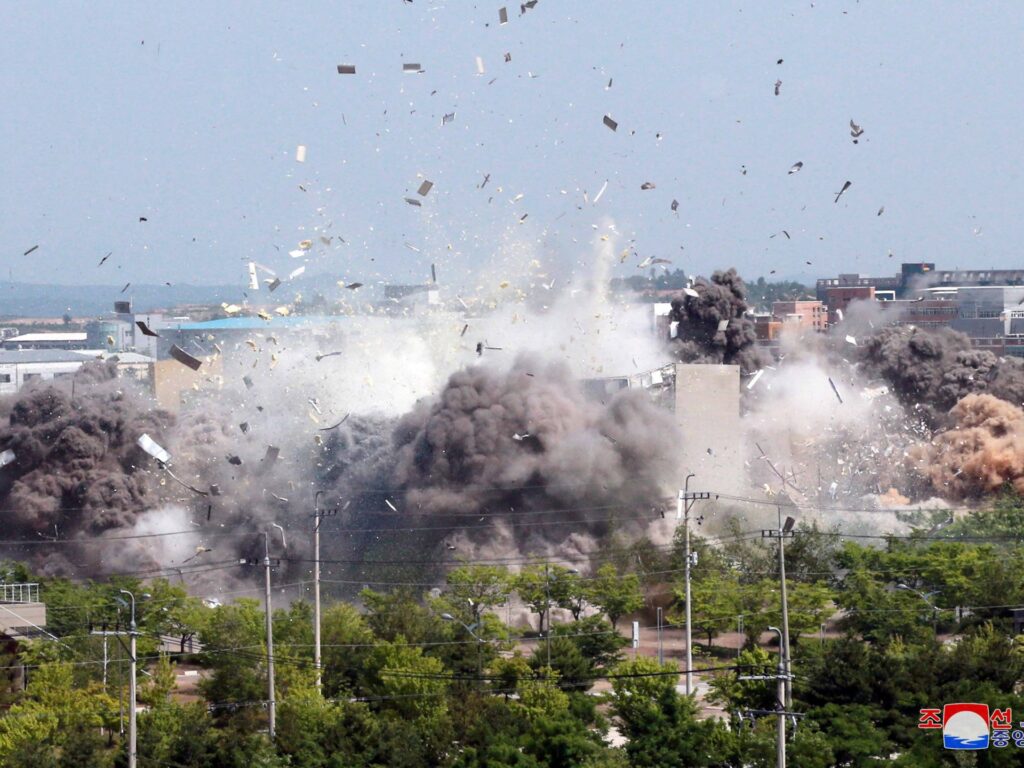
In a landmark ruling, a court in Seoul has ordered North Korea to pay $32.5 million in damages for the destruction of the Inter-Korean Liaison Office building. The building, which served as a symbol of inter-Korean cooperation, was blown up by North Korea in June 2020 amid escalating tensions between the two Koreas.
The Inter-Korean Liaison Office was established to improve communication and relations between North and South Korea. Located in the Kaesong Industrial Region, the office functioned as a crucial channel for dialogue after years of conflict and strained relations.
On June 16, 2020, North Korea demolished the four-story building with explosives. This act marked a significant deterioration in inter-Korean ties and sent shockwaves through the international community. The destruction came after days of heightened tensions, which included North Korea’s criticism of South Korean activists and disappointment about Seoul’s handling of joint projects.
The incident underscored the fragility of peace efforts on the Korean Peninsula. South Korea condemned the act as a clear violation of agreements between the two Koreas aimed at peaceful engagement and cooperation.
The Seoul court’s decision, which came nearly four years after the incident, holds Pyongyang financially accountable for the damage caused. The $32.5 million compensation reflects the estimated costs of the building as well as associated damages resulting from its destruction.
Legal experts say the ruling is largely symbolic since enforcing such judgments on North Korea is incredibly challenging due to geopolitical realities and lack of direct diplomatic relations.
Nevertheless, the verdict serves as an official acknowledgment of North Korea’s actions and provides some measure of justice for South Korea. It sends a strong message that acts of aggression have consequences even in the complex context of the Korean Peninsula.
The Inter-Korean Liaison Office was a groundbreaking initiative introduced in 2018 during a period of thawing relations and historic summits between North Korean leader Kim Jong-un and South Korean President Moon Jae-in.
The office facilitated numerous meetings, communication, and joint efforts that were intended to reduce tensions and promote peaceful coexistence. Its destruction ended a crucial communication line and contributed to the renewed stalemate in inter-Korean relations.
International observers have emphasized the importance of dialogue and de-escalation on the Korean Peninsula, urging both sides to return to negotiations and rebuild trust.
The Seoul court ruling might influence future legal and diplomatic stances, highlighting the importance of accountability in promoting peace and stability.
South Korea has repeatedly called for North Korea to engage in meaningful dialogue and to respect agreements aimed at reducing hostility and fostering cooperation.
While the ruling does not include any enforcement mechanism, it is expected to bolster South Korea’s position in international forums and in any future negotiations.
Experts note that the ongoing regional and global dynamics will continue to shape the prospects for reconciliation and peace on the Korean Peninsula.
The $32.5 million damages verdict underscores the economic and political costs of conflict and underlines the value of sustained diplomatic engagement.
As tensions remain volatile, the international community remains watchful, encouraging efforts aimed at peace, security, and mutual understanding between North and South Korea.
Overall, the Seoul court’s decision is a historic move that resonates beyond legal realms, symbolizing a call for responsibility and the hope for eventual peaceful reunification efforts.