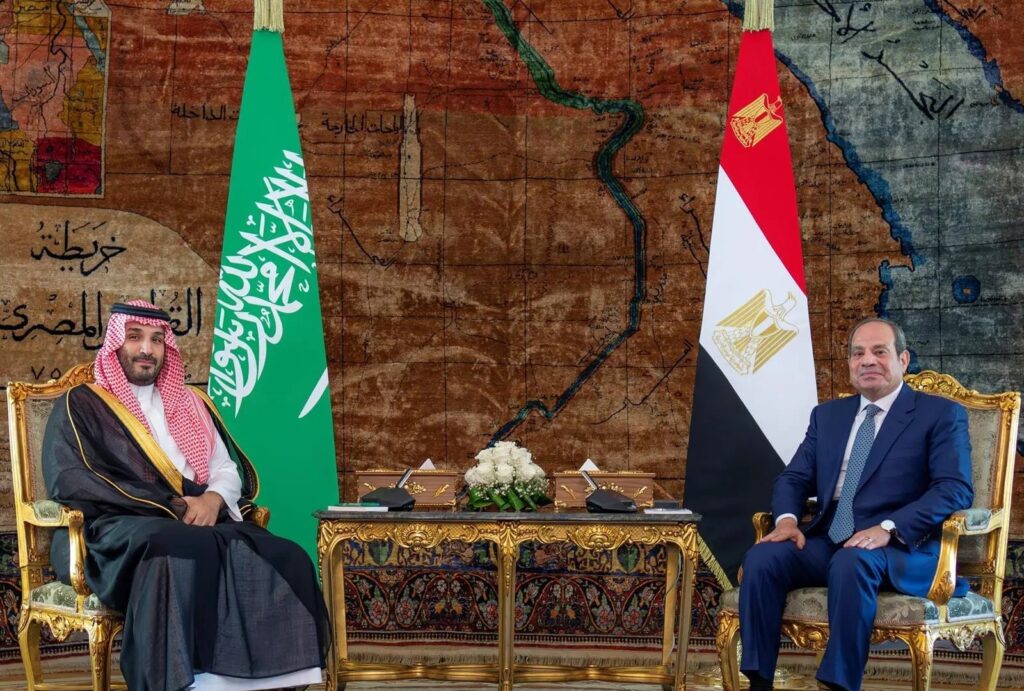
In a significant diplomatic engagement, Egypt’s President Abdel Fattah el-Sisi recently met with Saudi Crown Prince Mohammed bin Salman (MBS) to discuss critical regional security issues, emphasizing the importance of safe and secure navigation in the Red Sea. The Red Sea is a crucial maritime route facilitating international trade, and disruptions in this area have far-reaching economic implications, particularly for Egypt.
The meeting comes amid heightened concerns over the security situation in the Red Sea, a vital artery for global shipping and energy supplies. Both leaders underscored the necessity of cooperative measures to ensure uninterrupted maritime traffic along this strategic corridor.
Egypt, whose economy is deeply intertwined with Red Sea trade routes, has notably suffered economic setbacks due to disruptions in this region. The Suez Canal, one of the world’s busiest waterways, has experienced a significant decline in revenues, dropping by approximately $7 billion over the past two years. This downturn highlights the canal’s sensitivity to regional instability and the broader impact on Egypt’s national economy.
President Sisi’s endorsement of Saudi Arabia’s call for enhanced security measures in the Red Sea reflects shared concerns and a commitment to regional stability. The Saudi initiative aims to promote collaborative security frameworks that can safeguard maritime routes from threats including piracy, terrorism, and military conflicts.
The Red Sea serves as a critical junction connecting the Mediterranean Sea through the Suez Canal to the Indian Ocean, facilitating the transit of billions of dollars in goods annually. Any disturbance in this corridor can lead to increased shipping costs, delays in delivery, and broader economic repercussions for countries dependent on its stability.
During their discussions, both leaders highlighted the strategic importance of the Red Sea not only for their countries but for the international community at large. They voiced their support for multilateral approaches that involve regional stakeholders and international partners to maintain peace and security in the region.
The economic impact on Egypt has been especially acute, with the reduction in Suez Canal revenues affecting public finances and investment in critical infrastructure projects. The canal’s performance is a bellwether for Egypt’s economic health, and its downturn underscores the urgency for coordinated efforts to restore confidence among global shipping operators.
In addition to economic considerations, the meeting between Sisi and MBS reflected their broader strategic partnership. Strengthening cooperation on security, trade, and regional stability remains a priority for both nations, particularly given the complex geopolitical environment encompassing the Middle East and North Africa.
As Egypt and Saudi Arabia join forces to address Red Sea challenges, their collaboration sends a strong message about the importance of unity and collective action in the face of security threats and economic uncertainties. Ensuring the free flow of maritime trade in the Red Sea is not just a regional imperative but a global one, vital for the stability of international markets and energy supplies.
Looking ahead, observers expect continued high-level engagements between Egypt and Saudi Arabia aimed at reinforcing maritime safety and exploring joint measures that could enhance resilience against future disruptions. Such cooperation may also extend to intelligence sharing, naval coordination, and infrastructure security enhancements.
The commitment from both Cairo and Riyadh to a secure Red Sea reflects an understanding that security in this maritime corridor underpins broader regional prosperity and global economic stability. The Red Sea’s safe navigation remains a cornerstone for sustaining the economic development of Egypt and Saudi Arabia while protecting global trade flows.
In sum, the meeting between President Sisi and Crown Prince MBS highlights a pivotal step towards collaborative regional security efforts, addressing vital economic concerns tied to the Red Sea and signaling a unified front to bolster peace and prosperity in one of the world’s most strategic waterways.